
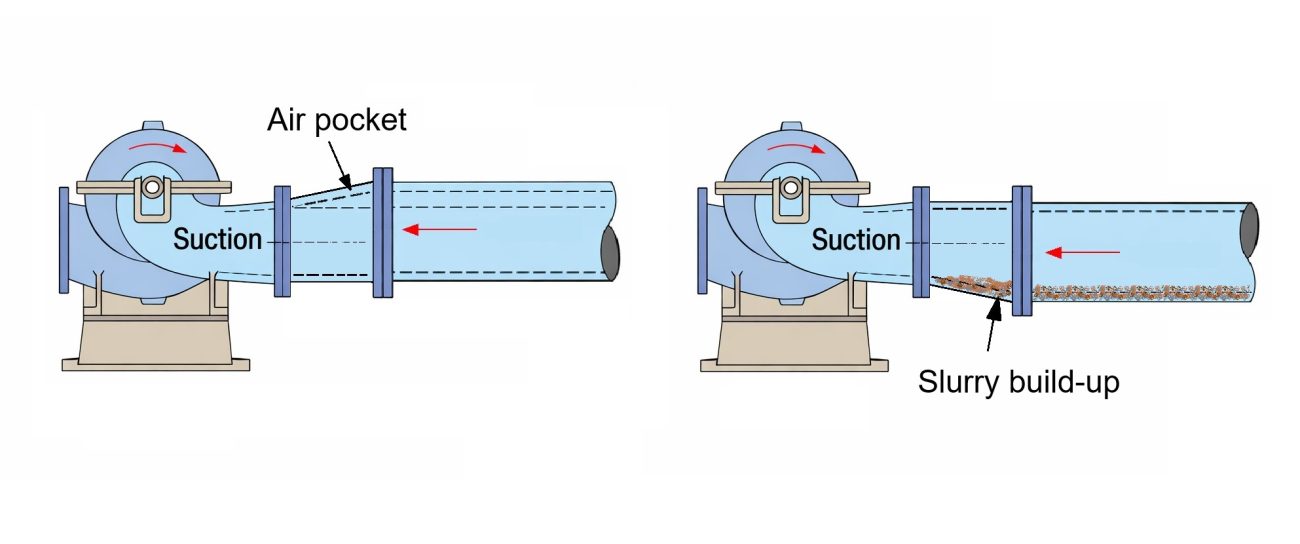
The statement “eccentric reducers must be installed flat side up” is common in pump rooms, site notes, and commissioning checklists. It is also incomplete.
Flat side up is often the right answer. It is not the only answer.
The reducer orientation depends on what you are trying to prevent at the pump suction. In one service, the main risk is an air or vapour pocket forming at the top of the suction line. In another, the bigger risk is solids settling along the bottom of the line. Good piping design does not follow a slogan. It follows the flow conditions in that specific service.
This article explains why eccentric reducers are used on pump suction lines, when flat side up is the correct orientation, when flat side down can be justified, and why the real design issue is not the fitting by itself but the behaviour of gas, vapour, and solids in the approach flow to the pump. Hydraulic Institute guidance stresses that suction piping should line up naturally, avoid strain, and avoid conditions that degrade suction performance, while other industry guidance notes that reducer orientation should discourage air-pocket formation at the pump inlet.
Why eccentric reducers are used at pump suction
A pump suction nozzle is often smaller than the suction pipe. When that happens, the pipe size has to reduce before the fluid enters the pump.
A concentric reducer creates a symmetrical transition. In a horizontal suction line, that symmetry can leave a high point where air or vapour collects. Once enough gas accumulates, the pump does not see a clean, full-bore liquid stream. Instead, it sees disturbed inflow, loss of available suction head, and a higher risk of cavitation, vibration, and unstable operation. Industry references consistently recommend eccentric reducers on horizontal pump suction lines because they reduce the chance of trapping gas at the top of the pipe.
That point matters because suction-side problems do not stay on the suction side. A poor inlet profile can upset the impeller eye, reduce performance, increase noise, and shorten seal and bearing life. The reducer is a small fitting, but it strongly influences what the pump “sees” at its inlet.
What “flat side up” is trying to achieve
Flat side up means the flat face of the eccentric reducer is on the top of a horizontal suction line. That arrangement removes the local high point where gas could collect.
For many clean-liquid pump services, this is the default orientation because the top of the line is where air or vapour wants to accumulate. If the top profile stays flat into the pump, bubbles are less likely to gather in a pocket immediately upstream of the suction nozzle. Pumps & Systems describes the same principle directly: install the flat side on top when fluid is coming from below the pump, and use the bottom orientation when fluid comes from above, with the purpose of discouraging air-pocket formation at suction. ScienceDirect’s engineering reference makes the same point in simpler form: straight side up avoids trapping vapours and reduces cavitation risk.
This is why flat side up is so widely repeated. In many water, chemical, and general process duties, it is a sound rule of thumb.
It is also why fire pump guidance is commonly taught as flat side up on the suction reducer. NFPA-related commentary and manufacturer literature associated with fire pump assemblies show the eccentric suction reducer installed with the straight side on top to avoid air pockets at the pump suction.
Why the rule is not universal
The problem with slogans is that they hide the design basis.
An eccentric reducer does not exist to satisfy a drafting convention. It exists to manage phase separation and flow approach. Once you think in those terms, the simple rule starts to break down.
If the liquid source is below the pump, the suction line may be more prone to air ingress, poor priming, or local gas accumulation at the top of the line. In that case, flat side up is usually the safer orientation because it prevents a top-side air pocket from forming just before the pump. Several technical references state this explicitly.
If the liquid source is above the pump, the line is flooded. In some layouts, guidance shifts to flat side down so that any gas can remain at the upper part of the line and move through rather than being trapped by the reducer geometry. Pumps & Systems states this directly for cases where fluid comes from the top, and process-piping guidance makes the same distinction between source-above and source-below arrangements.
That is the first reason the statement is incomplete: the direction of approach flow matters.
The second reason is the fluid itself.
When flat side down can be the better choice
There are services where gas pocketing is not the dominant concern. Slurry duty is the classic example.
If the pumped liquid carries suspended solids, a flat-side-up arrangement can create a low-velocity zone along the bottom where solids settle. Once solids settle, the suction profile changes. The line can partly block, the inlet flow becomes uneven, and the pump starts operating under conditions it was not designed to handle. In those cases, some engineers deliberately install the eccentric reducer flat side down to keep the bottom of the line flat and reduce solids deposition. Technical commentary on reducer orientation acknowledges this trade-off: flat side up helps gas pass, while flat side down can be selected where heavier immiscible material or solids settlement is the greater risk.
That does not mean every slurry pump should use flat side down. It means the designer must decide which failure mode is more credible:
- trapped gas or vapour at the top of the line
- settled solids at the bottom of the line
The correct orientation is the one that controls the more dangerous mechanism in that service.
The deeper design issue: reducer orientation is only one part of suction design
Reducer orientation gets attention because it is visible. The more important issues are often less obvious.
A well-oriented reducer cannot fix a bad suction arrangement. If the pump has no straight run upstream, an elbow is mounted hard against the suction nozzle, the line velocity is too high, the pipe is undersized, or the piping is pulling the pump out of alignment, the pump can still suffer from poor suction performance. Hydraulic Institute guidance emphasises natural alignment of piping, independent support, and avoidance of strain at pump nozzles because pipe strain and disturbed approach flow contribute to leakage, vibration, misalignment, and other reliability problems. HI also recommends eccentric reducers and sufficient straight pipe upstream where space permits.
So the deeper lesson is this: reducer orientation should be decided as part of the suction design, not as an isolated installation rule.
Ask these questions:
- Is the suction line flooded or lifting?
- Is the fluid clean, gassy, flashing, viscous, or solids-laden?
- Where will gas collect in this geometry?
- Where will solids settle in this geometry?
- Is the flow entering the pump uniformly, or is the reducer only one of several upstream disturbances?
That is how you move from rule-of-thumb piping to reliable pump intake design.
A practical orientation guide
Use the guide below as a starting point, then check it against the actual service.
| Service condition | Usual concern | Typical reducer orientation |
|---|---|---|
| Clean liquid, source below pump | Air or vapour pocket at top of suction line | Flat side up |
| Clean liquid, flooded suction from above | Avoid trapping gas in reducer geometry | Often flat side down |
| Slurry or solids-laden service | Solids settling at bottom of suction line | May justify flat side down |
| Fire pump suction | Avoid air pockets at suction entry | Flat side up |
This is a design guide, not a substitute for project standards or pump-specific requirements. The common thread is simple: choose the orientation that keeps the suction line full, stable, and free of the phase separation most likely to damage performance. That approach matches the reasoning found across pump-industry guidance, even where the simplified field rule differs by service.
Conclusion
“Eccentric reducers must be installed flat side up” is a useful training rule for many pump suction lines. It is not a universal law.
Flat side up is usually correct when the goal is to stop air or vapour collecting at the top of a horizontal suction line. That is why it is so common in clean-liquid and fire pump applications. But when the suction is flooded from above, or when solids settlement is the more serious risk, flat side down may be the better engineering choice.
The right question is not “What is the standard rule?” The right question is “What is most likely to collect in this line, where will it collect, and what will that do to the pump?”
That is the level of thinking reliable suction piping requires.
Key takeaways
- Eccentric reducers are used on horizontal pump suction lines to reduce the risk of trapped air or vapour pockets.
- Flat side up is often correct for clean-liquid suction lines, especially where the source is below the pump.
- Flat side down can be justified for flooded suction layouts or solids-laden service where bottom settlement is the bigger risk.
- The fitting orientation should be based on likely phase separation in the line, not habit.
- A correctly oriented reducer will not fix poor suction piping layout, high velocity, short straight runs, or pipe strain.
Last Updated on April 1, 2026 by TPE
