
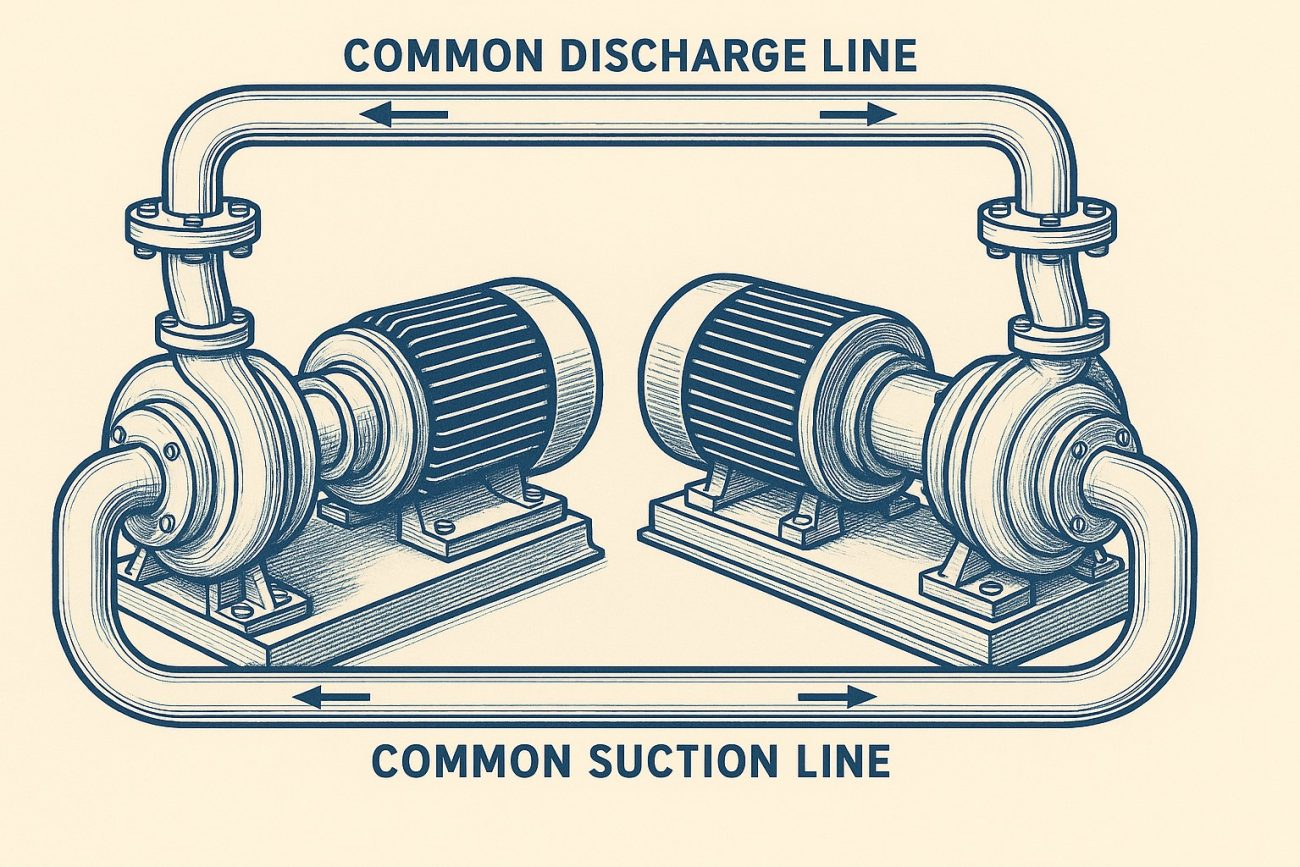
In many plants, space and piping costs drive the decision to connect multiple pumps to a shared suction line or a shared discharge header. On paper, it looks neat and efficient. In practice, it can introduce serious operational headaches if not designed carefully.
Common Suction Lines
When two or more pumps draw from the same suction line or tank nozzle, you need to watch out for:
- Unequal flow distribution – Pumps rarely pull evenly. One may dominate, starving the other.
- Starved suction – High velocity in the common line can cause pressure drop and cavitation.
- Air entrainment – If one pump cavitates or pulls in air, it can destabilise the whole system.
- NPSH issues – The common line adds friction losses, effectively reducing available NPSH.
Best practices:
- Keep suction lines short, large in diameter, and balanced.
- Install pumps as close as possible to the source.
- Use individual suction branches from a header, with equal lengths and diameters where possible.
- Keep velocity under 1 m/s (3 ft/s) in suction headers to reduce losses.
Common Discharge Lines
Multiple pumps discharging into a shared header can also create problems:
- Backflow between pumps – If one pump is idle, fluid can reverse through it without check valves.
- Pressure imbalance – Different pump curves can cause one unit to “fight” the other.
- Surging and vibration – Especially in positive displacement pumps without pulsation dampeners.
- Control issues – Flow control valves and instruments may see unstable conditions if pumps interact.
Best practices:
- Always fit check valves on each discharge branch.
- Include isolation valves for maintenance.
- Size headers to keep velocity below 2–3 m/s (6–10 ft/s).
- When pumps run in parallel, ensure they are hydraulically matched and operate near the same duty point.
Key Design Considerations
- Pump type matters. Centrifugal pumps are more forgiving than positive displacement pumps in shared headers.
- Balance is critical. If lines are uneven, one pump can carry the load while the other barely contributes.
- Startup sequence. In shared lines, poor sequencing can cause pressure spikes or air pockets.
- Instrumentation. Install pressure gauges on each suction and discharge branch to monitor imbalances.
Final Word
Shared suction and discharge piping can save space and cost—but it’s never “free.” Poor design can lead to cavitation, surging, backflow, and premature pump failures. If you must use common headers, keep velocities low, balance the branches, and add check and isolation valves.
The golden rule: design the system to protect the pumps, not just to simplify the piping layout.
Last Updated on October 21, 2025 by TPE
