
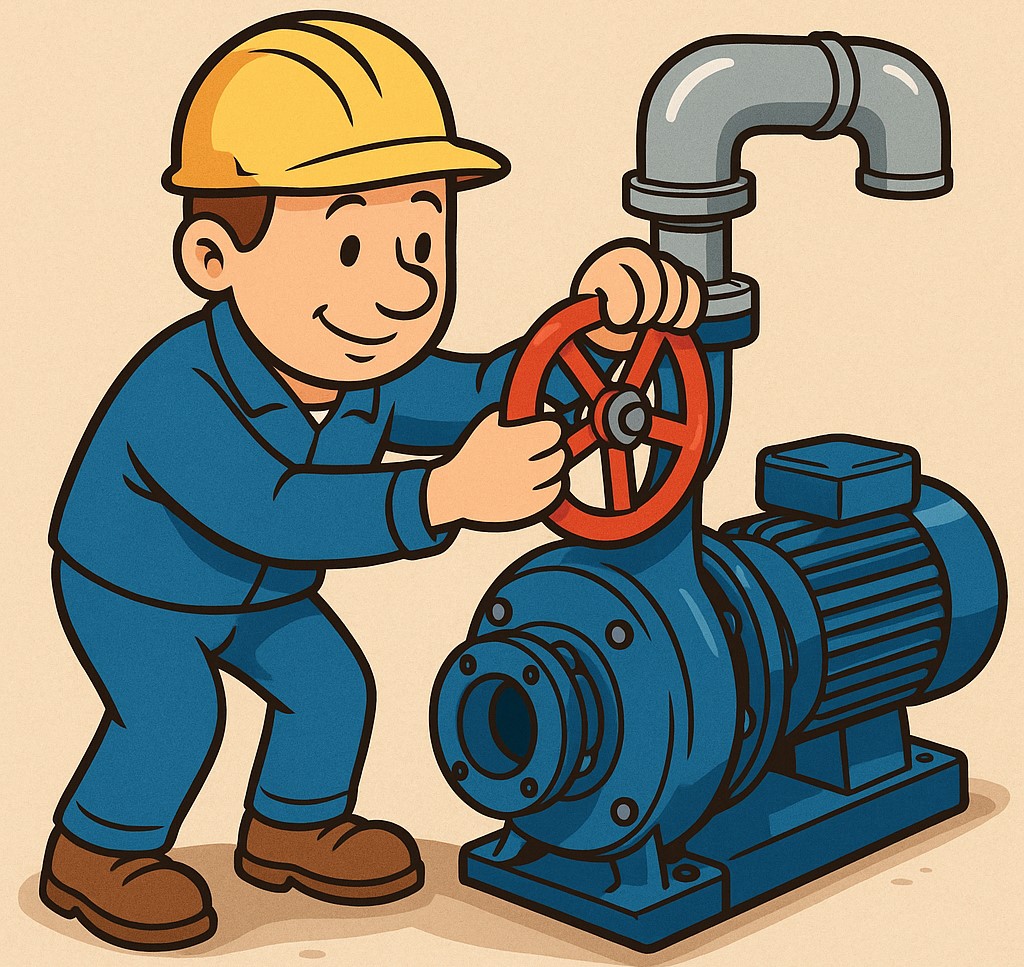
Throttling a pump’s discharge valve is one of the most common methods used to control flow — especially in older systems or installations without variable speed drives. While it might seem like a simple and effective way to adjust flow rate, throttling introduces hidden inefficiencies that can cost you energy, money, and equipment life over time.
Let’s break down what actually happens when you throttle a discharge valve — and why it’s often not the best solution.
What Happens When You Throttle the Valve
When you partially close a discharge valve on a centrifugal pump, you’re increasing the resistance (or head loss) in the discharge line. This shifts the operating point along the pump curve to a lower flow and higher head.
The pump itself doesn’t “slow down” — it continues spinning at the same speed, drawing power from the motor. The energy that would normally move fluid is instead lost as friction and turbulence at the valve.
In simple terms: you’re wasting energy by converting useful hydraulic power into heat and noise.
The Main Inefficiencies
1. Energy Loss
Throttling is like driving your car flat-out while pressing the brake pedal halfway down. The motor still consumes nearly the same amount of power, but much of it is dissipated across the valve instead of performing useful work.
In systems with large flows or continuous operation, these losses can add up quickly — sometimes wasting thousands of kilowatt-hours per year.
2. Excessive Pressure and Mechanical Stress
Partially closed valves create a pressure drop that can generate cavitation and vibration downstream, particularly in high-head systems. This leads to premature wear on valve seats, seals, and even the pump itself.
If the pump operates too far left on its performance curve, it can also experience radial thrust imbalances and shaft deflection — both of which shorten bearing and seal life.
3. Reduced Control Accuracy
Throttling is a blunt instrument. Small adjustments in valve position can cause large swings in flow, especially near closed positions. This makes precise process control difficult, particularly in applications with fluctuating system pressures.
4. Higher Maintenance Costs
The combination of turbulence, vibration, and cavitation not only wastes energy but also damages components. The discharge valve may need frequent servicing, and in extreme cases, throttling can even cause erosion of downstream piping.
When Throttling Might Be Acceptable
Not all throttling is bad — it has its place. For example, using a valve for fine-tuning during commissioning or temporary adjustments is acceptable.
But if throttling is your main method of flow control, it’s a sign that the system isn’t optimised. Over time, the operating point will drift, efficiency will drop, and operating costs will climb.
Better Alternatives
If you find yourself constantly throttling to control flow, consider these alternatives:
- Variable Speed Drives (VSDs): Adjusting pump speed is by far the most energy-efficient way to control flow in centrifugal pumps.
- Pump Selection Review: Ensure the pump is sized correctly for your system’s actual duty point, not just the maximum design condition.
- Bypass or Control Loops: In some process systems, flow control can be managed with recirculation lines or automated control valves designed for efficiency.
A Quick Example
Let’s say your pump draws 45 kW at full flow (100 m³/h). To reduce flow to 70 m³/h, you throttle the discharge valve — the pump still consumes around 42 kW.
If instead, you used a VSD to slow the pump to match the new duty point, power consumption might drop to 25–30 kW.
Over a year of continuous operation, that difference could save over 100,000 kWh, or roughly $20,000 in energy costs, depending on your tariff.
Key Takeaway
Throttling discharge valves may seem convenient, but it’s a false economy. The energy wasted, the added mechanical stress, and the long-term maintenance costs far outweigh the short-term convenience.
Whenever possible, design or retrofit your system for true control efficiency — through correct pump sizing, variable speed operation, and good hydraulic design.
Your pumps — and your power bills — will thank you for it.
