
How to Avoid Cavitation and Ensure Proper Suction Conditions
Net Positive Suction Head (NPSH) is one of the most important – and misunderstood – concepts in pump system design. Getting it wrong can lead to cavitation, severe damage to your pump, and costly downtime. This page helps you understand what NPSH means, how to calculate it, and how to design your system to avoid problems.
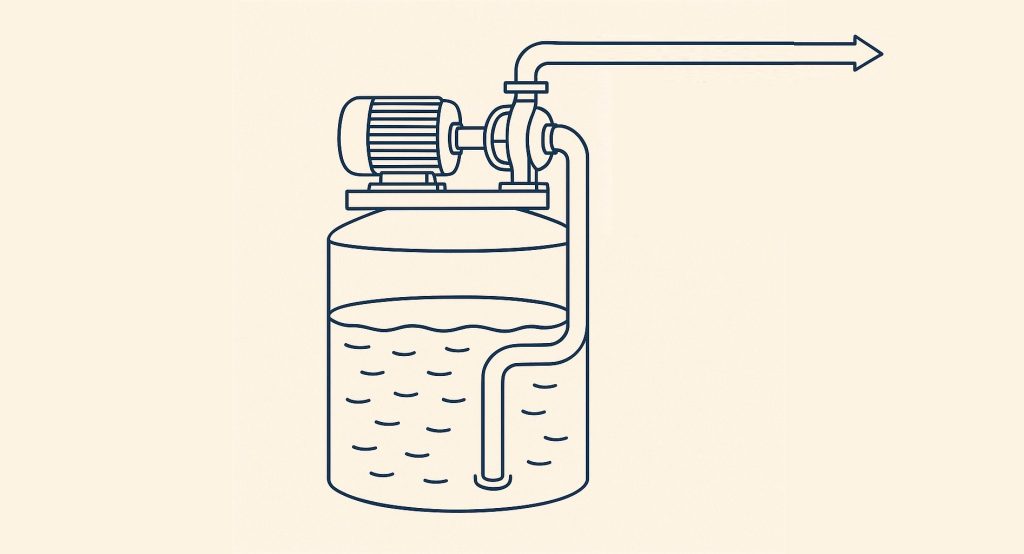
What is NPSH?
NPSH stands for Net Positive Suction Head and comes in two forms:
- NPSHa (Available): The amount of pressure (in head) available at the suction port of the pump.
- NPSHr (Required): The minimum pressure (in head) the pump needs at the suction to avoid cavitation.
To operate safely and effectively, NPSHa must always be greater than NPSHr.
Why is NPSH Important?
NPSH exists to prevent cavitation – the formation and violent collapse of vapor bubbles inside the pump. Cavitation is caused when the pressure at the suction drops below the vapor pressure of the liquid. These bubbles collapse when pressure recovers inside the pump, causing:
- Noise and vibration
- Impeller and volute damage
- Seal failure
- Reduced flow and efficiency
Understanding and managing NPSH is essential for centrifugal pump reliability.
When Should You Worry About NPSH?
- If you’re using centrifugal pumps – NPSH is critical.
- When pumping hot or volatile liquids – higher vapor pressures increase cavitation risk.
- If you have long or narrow suction lines, valves, or multiple fittings – these increase friction losses.
- When the suction source is under vacuum or at a low elevation relative to the pump.
Note: Positive displacement pumps (like hose or peristaltic pumps) are much less affected by NPSH. Cavitation is generally not an issue because the fluid is fully contained and moved at lower velocities NPSH on hose pumps.
How to Calculate NPSHa
NPSHa = Static Head + Surface Pressure Head – Vapor Pressure – Friction Losses
In simple terms:
- Static head = Vertical distance from the liquid surface to the pump inlet.
- Surface pressure head = Pressure on the liquid surface, converted to head.
- Vapor pressure = The pressure at which the liquid boils at the pumping temperature.
- Friction losses = Head losses from suction piping, valves, and fittings.
You can calculate this using pressure-to-head conversions:
- PSI × 2.31 / Specific Gravity = Head (ft)
- Inches of mercury × 1.133 / Specific Gravity = Head (ft)
Want to calculate NPSH? Use our Pump Power Requirement Calculator to get started.
Example: Is Cavitation Likely?
Scenario:
- Pumping 100 GPM of water at 68°F
- Tank is at atmospheric pressure
- Liquid level: 5 ft above pump
- Suction line: 10 ft of 2” pipe + 1 elbow
- NPSHr from pump curve: 9 ft
Result:
- NPSHa = 36.04 ft → Safe. Well above the required NPSH, no cavitation risk.
But if the same setup involved hot condensate at 180°F with a vacuum tank, NPSHa could fall below zero – and cavitation would be certain NPSHA.
How to Improve NPSHa and Avoid Cavitation
- Raise the suction tank to increase static head.
- Enlarge suction pipe diameter to reduce friction loss.
- Minimize fittings, bends, and valves before the pump.
- Use a flooded suction setup where possible.
- Pressurize the suction vessel, if appropriate.
- Avoid pumping near vapor pressure (especially for hot or volatile fluids).
- Select pumps with lower NPSHr, or use a booster pump if needed.
NPSH and Pump Type
| Pump Type | Is NPSH a Concern? | Notes |
|---|---|---|
| Centrifugal | Yes | High speed and velocity make them vulnerable to cavitation |
| Peristaltic/Hose Pumps | No | Low speed, sealed fluid path – cavitation not an issueNPSH on hose pumps |
| Diaphragm | Sometimes | Depends on fluid, setup, and suction conditions |
| Gear or Lobe | Sometimes | Generally lower risk, but still needs consideration in some cases |
Summary: Don’t Let Cavitation Kill Your Pump
Understanding NPSH is key to reliable pump operation. By checking both NPSHa and NPSHr, and taking smart steps in your suction design, you can avoid cavitation damage and extend the life of your pump.
If you’re working with complex fluids or system designs, contact our team or use our online calculators to evaluate your setup.
Common FAQs about NPSH
- Q: What is the difference between NPSHa and NPSHr?
A: NPSHa (Net Positive Suction Head available) is the amount of pressure head available at the pump suction, while NPSHr (Net Positive Suction Head required) is the minimum suction head the pump needs to avoid cavitation. For safe operation, NPSHa must always be greater than NPSHr. - Q: How do you calculate NPSHa for a pump system?
A: NPSHa is calculated as Static Head + Surface Pressure Head − Vapor Pressure − Friction Losses, where static head is the vertical distance from the liquid surface to the pump inlet, surface pressure head is the pressure on the liquid surface converted to head, vapor pressure is the boiling pressure at the liquid temperature, and friction losses are head losses from suction piping, valves, and fittings. - Q: What practical steps can I take to improve NPSHa and prevent cavitation?
A: You can improve NPSHa by raising the suction tank to increase static head, enlarging the suction pipe to reduce friction losses, minimizing fittings and bends, using a flooded suction or pressurizing the suction vessel if appropriate, avoiding pumping near the fluid’s vapor pressure, and selecting pumps with lower NPSHr or adding a booster pump.
Last Updated on October 24, 2025 by TPE