
Air operated diaphragm pumps are often chosen because they can self-prime, handle solids, and tolerate difficult fluids. That flexibility can create a common installation mistake: treating inlet pressure as if “more is better.”
It is not.
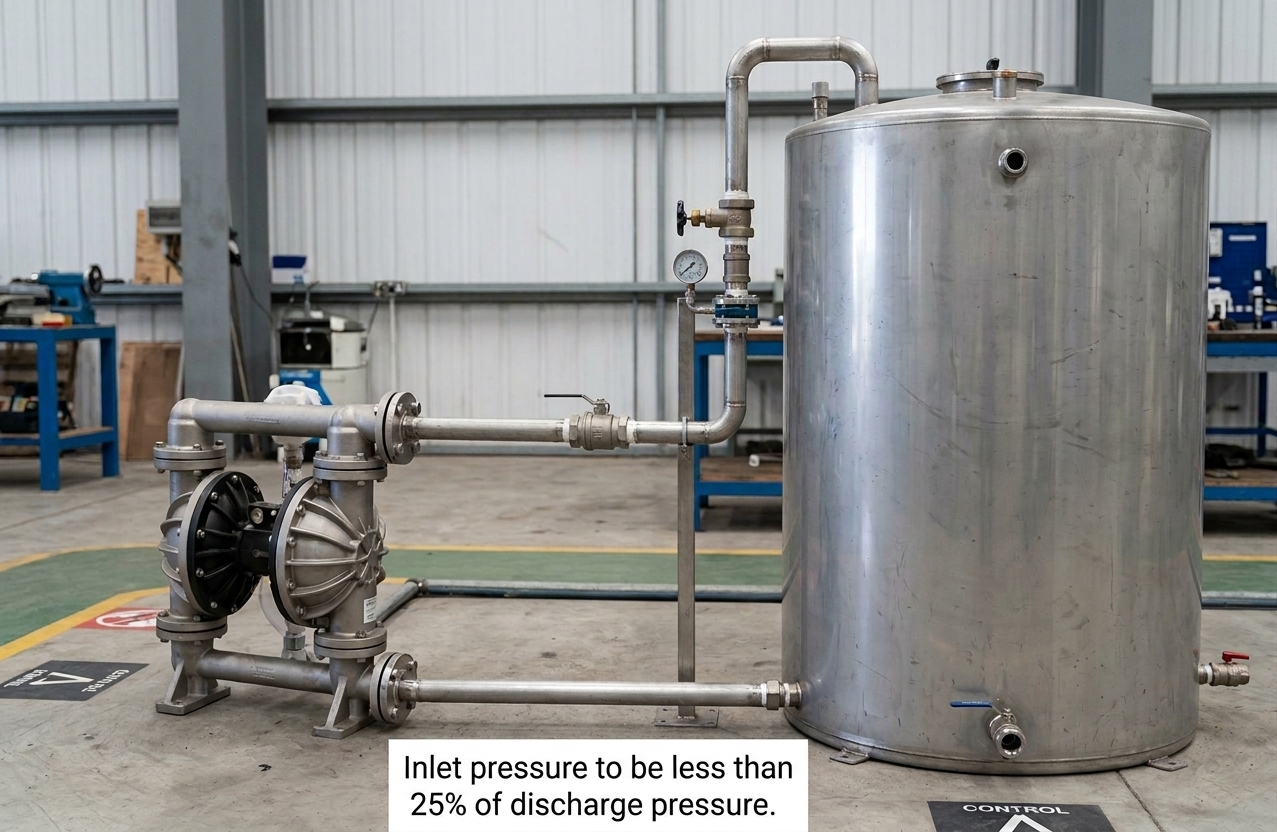
On an air operated diaphragm pump, too much positive inlet pressure can create poor check valve performance, unstable operation, and shorter diaphragm life. The exact limit depends on the pump design and the operating pressure, so there is no single universal number. But across multiple OEM manuals, two limits appear again and again: once inlet pressure rises above about 25% of outlet working pressure, check valves may stop closing properly, and once flooded inlet pressure rises above about 15 psi (around 1 bar), diaphragm life is often reduced. Some manuals also note that only a small positive suction pressure, around 3 to 5 psi, is enough for many duties.
This article explains what “maximum inlet pressure” really means on an air operated diaphragm pump, why excessive inlet pressure causes trouble, and how to set up a flooded suction system without damaging performance or reliability.
What inlet pressure means on an AODD pump
Inlet pressure is the pressure at the pump suction connection. On an air operated diaphragm pump, this pressure can come from static liquid head in a flooded suction arrangement, a pressurised feed vessel, or a combination of both.
A flooded suction means the liquid level sits above the pump inlet, so gravity creates positive pressure at the suction side. That can help priming and reduce suction losses, but it can also create problems if the pressure is too high. Unlike some other pump types, an AODD pump relies on check valves opening and closing cleanly during each stroke. Excessive inlet pressure can interfere with that timing and reduce pumping efficiency.
That is why “maximum inlet pressure” should not be read as a single catalogue number unless a manufacturer gives one explicitly for a particular model. In practice, you need to look at inlet pressure relative to the pump’s operating conditions.
Why too much inlet pressure causes problems
The first issue is check valve control.
In an AODD pump, suction and discharge are controlled by ball or flap check valves. During the pumping cycle, those valves need to seat quickly and reliably. Several manufacturer manuals warn that if inlet fluid pressure exceeds 25% of outlet working pressure, the ball checks may not close fast enough. When that happens, the pump can lose efficiency, deliver unstable flow, and behave as though it is oversized or incorrectly valved.
The second issue is diaphragm loading.
The diaphragms in an AODD pump flex back and forth under repeated pressure cycling. Higher suction-side pressure increases the force acting on the diaphragm assembly, even before discharge pressure is considered. Multiple manuals state that inlet pressures above about 15 psi, or roughly 1 bar, shorten diaphragm life. That does not always mean immediate failure, but it does increase stress and can reduce maintenance intervals.
The third issue is operating instability.
When suction pressure is too high, symptoms can resemble other faults: erratic cycling, reduced capacity, premature diaphragm wear, or poor check valve sealing. Some troubleshooting guides identify “excessive flooded suction pressure” as a cause of premature diaphragm failure and recommend reducing inlet pressure by raising the pump, moving it closer to the source, or adjusting the system layout.
The practical limit: there is no single universal number
This is the key point.
For most air operated diaphragm pumps, the practical maximum inlet pressure is not simply the mechanical pressure rating of the casing. It is the lower of:
- the manufacturer’s specific inlet pressure limit for that pump
- about 25% of the pump’s outlet working pressure for efficient check valve operation
- the inlet pressure level where diaphragm life starts to fall off, often around 15 psi or 1 bar on many common designs
That means the answer changes with operating conditions.
For example, if a pump is running with an outlet working pressure of 4 bar, then 25% of that is 1 bar. In that case, the check valve limit and the diaphragm-life warning line up closely. If the pump is running at only 2 bar discharge pressure, then 25% is 0.5 bar, so the practical inlet pressure limit may be lower than the 1 bar diaphragm-life threshold.
This is why a system can run badly on flooded suction even when the pump itself is not technically overpressure. The pump may be inside its casing pressure rating but outside its good operating range.
A simple way to estimate flooded inlet pressure
For open tanks, the main contributor is static head. Water creates about 0.098 bar per metre of liquid height, which is close enough in practice to 0.1 bar per metre. A liquid level 5 m above the pump inlet therefore gives roughly 0.5 bar inlet pressure, before friction losses are considered.
That matters quickly on AODD pumps.
A pump sitting 10 m below a full tank can see about 1 bar of flooded suction from static head alone. On many AODD installations, that is already in the range where diaphragm life may be affected. If the pump is operating at relatively low discharge pressure, it may also exceed the “25% of outlet pressure” rule.
For heavy fluids, the problem becomes more pronounced because static pressure increases with specific gravity. A dense slurry or chemical can create more inlet pressure than water for the same liquid height.
What inlet pressure is usually enough
Many AODD pumps do not need much positive suction pressure to perform well. One sanitary diaphragm pump manual states that an inlet pressure supply of 3 to 5 psi, or about 0.2 to 0.3 bar, is adequate for most materials. That is a useful rule of thumb: use only the positive suction pressure needed for stable feed, not the maximum the layout happens to create.
In real systems, the goal is usually modest flooded suction, not high flooded suction.
A small positive head can help with viscous liquids, priming reliability, and NPSH margin. NPSH stands for Net Positive Suction Head, the pressure available at the pump inlet above the liquid vapour pressure. While cavitation behaviour in AODD pumps differs from centrifugal pumps, suction conditions still matter. Low losses and steady inlet conditions improve consistency.
Signs your inlet pressure is too high
An AODD pump with excessive inlet pressure may show one or more of these symptoms:
- reduced pumping efficiency even though air supply looks normal
- unstable or inconsistent cycling
- check valves that do not seat cleanly
- premature diaphragm wear
- repeated maintenance issues in a flooded suction installation
These symptoms are easy to misread. A team may increase air pressure, change valve components, or assume the fluid is the problem. In some cases, the real issue is simply too much static head at the inlet.
How to control inlet pressure in practice
Start with the installation layout.
If the pump sits far below the source vessel, calculate the static head at maximum tank level, not just normal level. That gives the worst-case inlet pressure.
Next, compare that pressure with the actual operating discharge pressure. If the inlet pressure approaches 25% of outlet working pressure, treat that as a warning sign even if the pump still runs. If the flooded suction pressure is near or above 1 bar on a common AODD design, expect shorter diaphragm life unless the model is explicitly designed for more.
Then adjust the system if needed. Common fixes include:
- raising the pump relative to the liquid source
- reducing the maximum liquid level above the pump
- using a break tank instead of direct high-head feed
- controlling feed vessel pressure
- checking whether a backpressure or dampening arrangement is required in that specific system configuration
Finally, verify the pump manual. Some models have specific allowances or limitations based on materials, valve design, and port size. General rules are useful, but the model-specific manual remains the final reference.
The bottom line
The maximum inlet pressure on an air operated diaphragm pump is not a single universal figure. In practice, the safe operating limit is often much lower than people expect.
Across common AODD guidance, two thresholds matter most: keep inlet pressure below about 25% of outlet working pressure to preserve check valve performance, and treat inlet pressures above roughly 15 psi, or 1 bar, as a diaphragm-life concern unless the pump documentation says otherwise. For many applications, only a small positive inlet pressure is needed.
That is why flooded suction should be designed, not assumed. A little inlet pressure helps. Too much can quietly shorten pump life.
Key takeaways
- Maximum inlet pressure on an AODD pump depends on pump design and operating pressure, not just the casing pressure rating.
- A common rule is to keep inlet pressure below 25% of outlet working pressure to avoid poor check valve seating.
- Many AODD manuals warn that inlet pressures above about 15 psi, or 1 bar, shorten diaphragm life.
- In many services, only 3 to 5 psi of positive inlet pressure is enough.
- High static head from flooded suction can create reliability problems even when the pump appears correctly sized.
- Always calculate worst-case suction head at maximum tank level and confirm it against the pump manual.
