

If you’ve been around pumps for a while, you’ve probably heard the term positive displacement. But what does it actually mean, and how is it different from a centrifugal pump?
At its simplest, a positive displacement (PD) pump is one that moves a fixed volume of liquid for every cycle or rotation. The pump “displaces” a set amount of fluid—positively, with no slip past the pumping element (at least in theory). That’s the defining feature.
How Positive Displacement Works
Instead of relying on velocity and pressure like a centrifugal pump, a PD pump works by trapping fluid inside a cavity and then physically pushing it out. This cavity can take many forms:
- A chamber formed by pistons or plungers
- A flexible hose squeezed by rollers or shoes
- Gears, lobes, or screws rotating against each other
- A diaphragm flexing back and forth
Each cycle, the trapped volume is displaced into the discharge line. Flow is therefore directly proportional to speed—double the RPM and you double the flow (ignoring slip).
Key Characteristics of PD Pumps
- Constant flow regardless of pressure: A centrifugal pump’s flow drops as system pressure rises. A PD pump, however, will continue delivering the same flow—right up until it reaches its mechanical or relief limit.
- Self-priming ability: Many PD pumps can lift fluid into themselves without external priming systems.
- Viscosity handling: Higher viscosity fluids often make PD pumps perform better, while centrifugal pumps struggle.
- High pressure capability: Because they don’t rely on velocity, PD pumps can generate high discharge pressures in relatively compact designs.
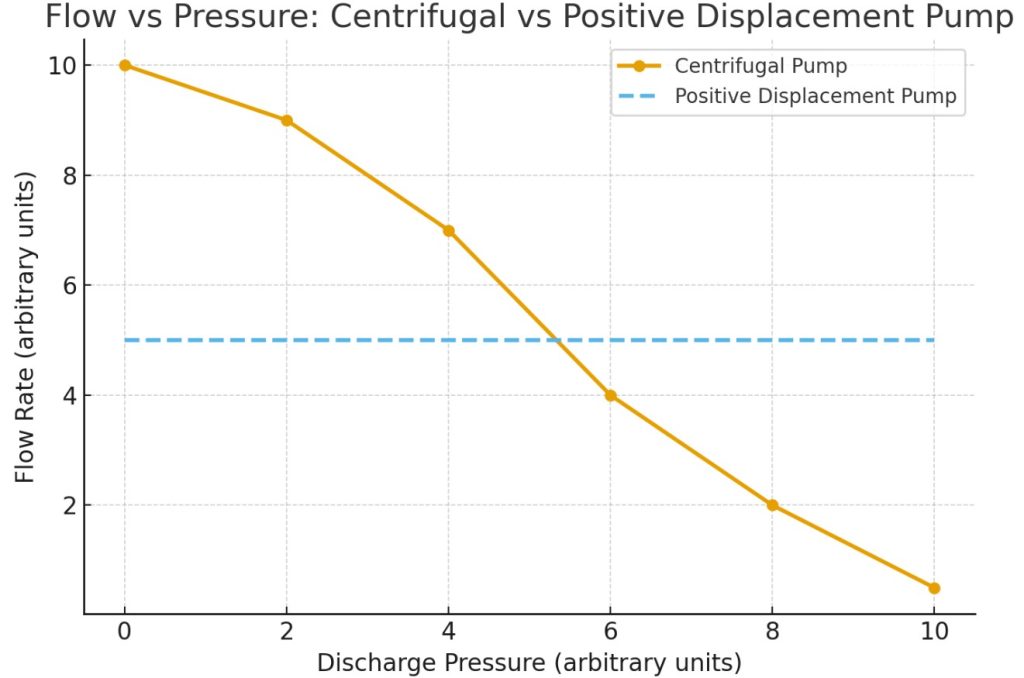
Here’s a simple diagram showing the difference: centrifugal pump flow drops as pressure rises, while a positive displacement pump maintains near-constant flow until it hits a relief point.
Where You’ll See Positive Displacement Pumps
- Dosing and metering: Chemical dosing skids often use diaphragm or piston pumps for accuracy.
- Food & beverage: Lobe and hose pumps handle thick, shear-sensitive fluids like yoghurt or fruit pulp.
- Mining & minerals: Hose and peristaltic pumps shine in abrasive lime slurries or tailings.
- Oil & gas: Screw pumps are common for crude transfer and multiphase fluids.
Why the Name Matters
Calling a pump “positive displacement” isn’t just jargon—it tells you what to expect. If you block the discharge, the pump will still try to push fluid. Pressure will rise rapidly until something gives (usually a relief valve, hopefully not the casing). With centrifugal pumps, a closed discharge simply stalls the flow without dangerous overpressure.
That’s why every PD pump should be installed with proper pressure relief protection.
In Summary
Positive displacement means the pump moves a definite amount of liquid each cycle, regardless of system pressure. It’s the opposite of a centrifugal pump, where flow depends heavily on head and system conditions.
Understanding this principle helps you select the right pump for the job:
- Need steady, accurate flow through changing pressures? PD is the way to go.
- Need high volumes at lower pressures? A centrifugal might be a better fit.
Last Updated on October 3, 2025 by TPE
