
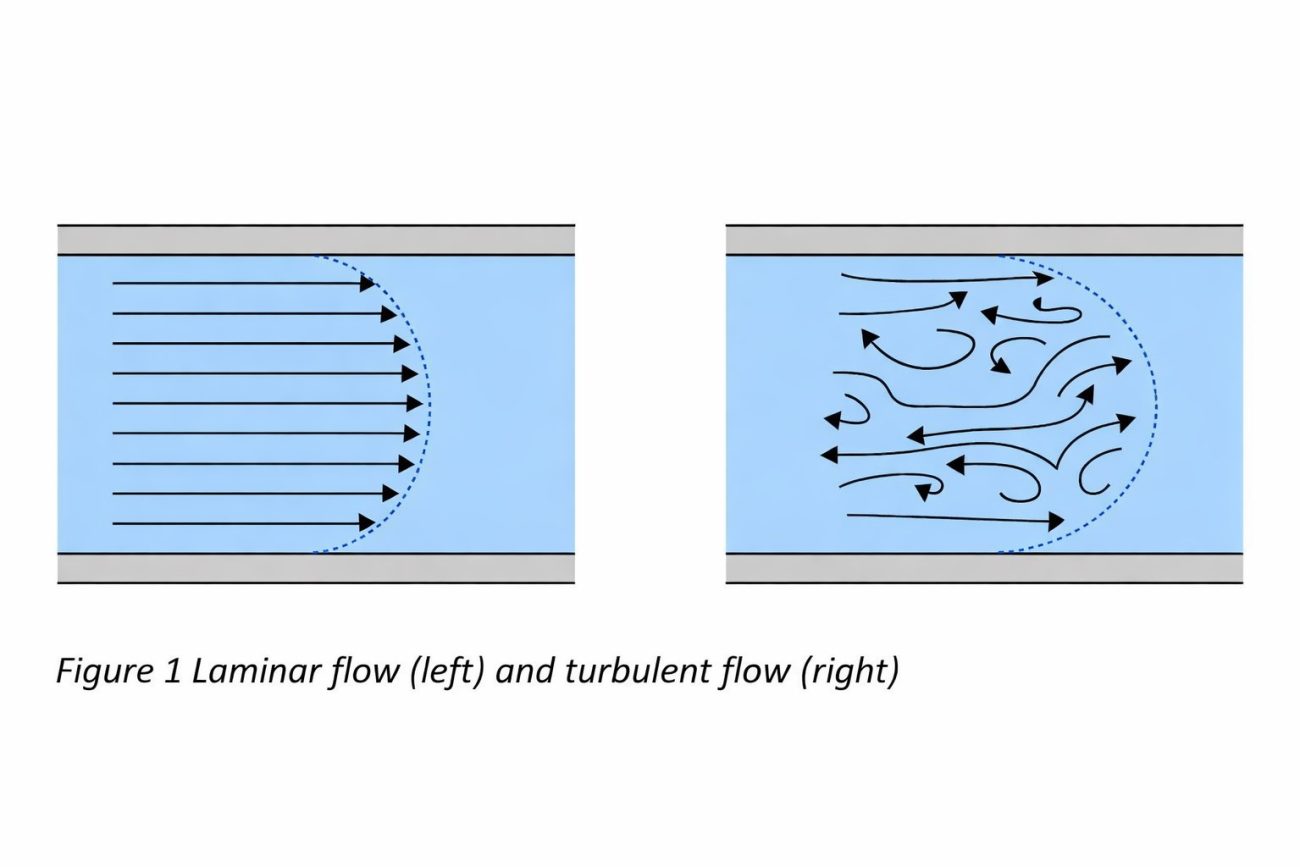
When engineers talk about fluid flow in pipelines, two terms often come up: laminar flow and turbulent flow. Understanding the difference is important because the type of flow in a system directly affects pump performance, pipe losses, and overall system efficiency.
What Is Laminar Flow?
Laminar flow occurs when fluid moves in smooth, parallel layers. Each layer slides over the one next to it with very little mixing.
This type of flow typically occurs when:
- Fluid velocity is low
- The fluid has high viscosity
- Pipe diameters are relatively small
In laminar flow, the velocity profile inside the pipe forms a parabolic shape. Fluid in the centre moves fastest, while fluid touching the pipe wall is almost stationary due to friction.
A common example would be thick oil slowly moving through a pipe.
From an engineering perspective, laminar flow generally occurs when the Reynolds number is below 2000.
What Is Turbulent Flow?
Turbulent flow is very different. Instead of smooth layers, the fluid moves in a chaotic pattern with eddies, swirls, and mixing.
This type of flow occurs when:
- Fluid velocity is higher
- Pipe diameters are larger
- Fluids have lower viscosity (like water)
In turbulent flow, the velocity profile across the pipe becomes much flatter, and there is constant mixing throughout the fluid.
Turbulent flow typically occurs when the Reynolds number exceeds 4000.
Between laminar and turbulent flow is a transition zone, where the flow may switch between the two depending on disturbances in the system.
Why This Matters for Pump Systems
In most industrial pumping applications, flow is turbulent. Water systems, slurry pipelines, chemical transfer lines, and mining processes all typically operate in this regime.
The reason this matters is because flow behaviour determines the friction losses in the pipe system, which directly affects pump selection.
Higher friction losses mean:
- The pump must generate more head
- Energy consumption increases
- System efficiency may decrease
This is why understanding the flow regime is important when calculating system curves and total dynamic head.
Laminar Flow and Pumping Systems
Laminar flow is less common in large industrial pipe systems, but it can occur in applications involving very viscous fluids, such as:
- Heavy oils
- Polymers
- Certain chemicals
- Food products
When laminar flow occurs, engineers need to be aware of one important distinction: friction losses in laminar flow are proportional to velocity — not velocity squared as in turbulent flow. This means standard pipe friction charts developed for water-based turbulent systems may no longer apply, and pump sizing calculations must account for viscosity corrections.
Positive displacement pumps are often preferred in these situations because they handle viscous fluids more effectively than centrifugal pumps, and their performance is less sensitive to fluid viscosity changes.
Turbulent Flow and Pumping Systems
Most pump systems are designed assuming turbulent flow conditions.
Under turbulent flow, pipe friction losses are governed by the Darcy-Weisbach equation, where losses increase with fluid velocity, pipe length, pipe roughness, and fluid density. This is why pipe diameter selection is so critical — undersized piping increases velocity, which drives up turbulence and friction losses, forcing the pump to work harder.
Correct pipe sizing helps reduce:
- Energy consumption
- Pump wear
- Operational costs
The Key Takeaway
Laminar and turbulent flow are not just theoretical concepts. They play a direct role in how pumping systems behave.
Understanding the flow regime helps engineers:
- Correctly calculate pipe friction losses
- Select the right pump type
- Optimise pipe sizing and system efficiency
In simple terms: flow behaviour determines system resistance, and system resistance determines the pump required to do the job.
Getting this right is one of the foundations of good pump system design.
Last Updated on March 13, 2026 by TPE
