
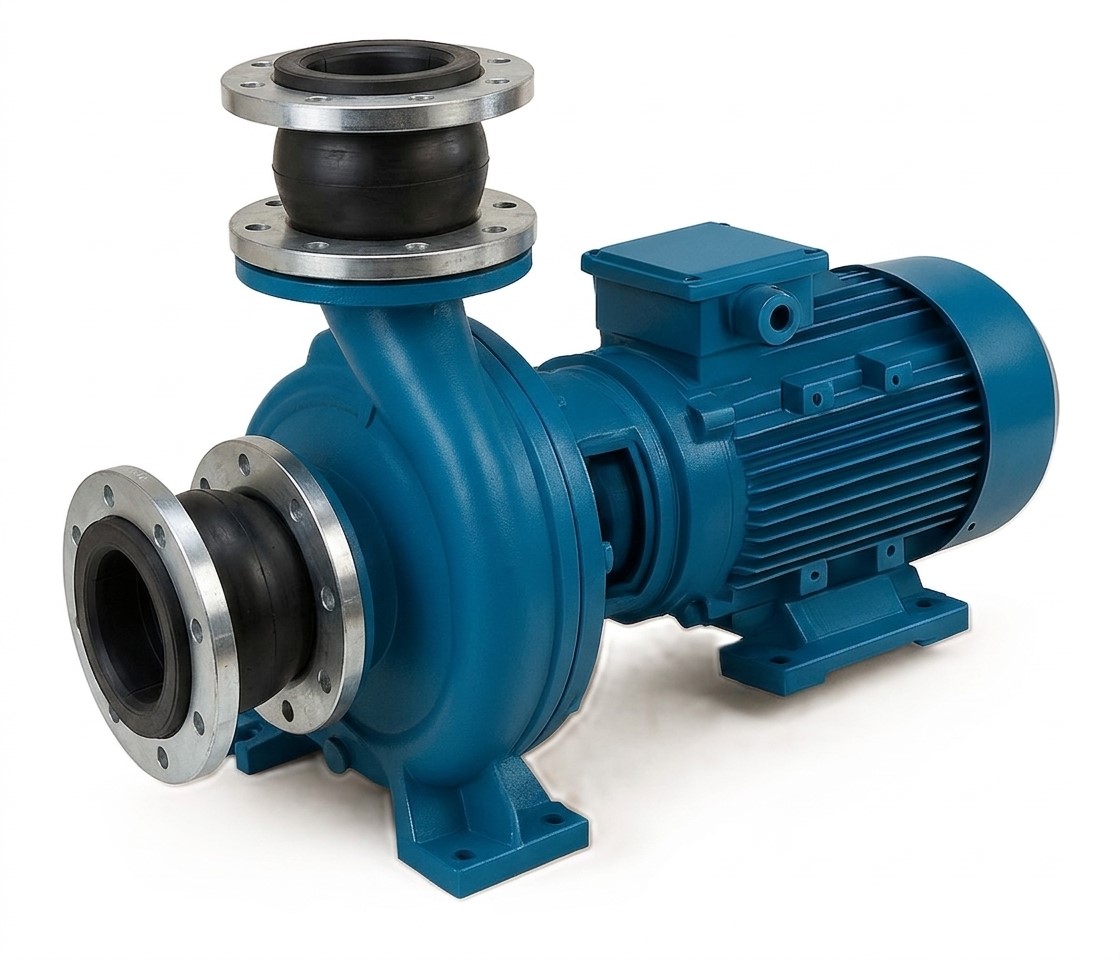
Rubber bellows are widely used in pump systems, but they are also widely misunderstood. In many installations, they are expected to solve problems they were never designed to fix.
The result is predictable: premature failures, pipe damage, and ongoing reliability issues.
This article explains what rubber bellows (expansion joints) actually do, how they behave under real operating conditions, and why misuse leads to repeated problems in both piping and pumps.
What a rubber bellow is designed to do
A rubber bellow, also known as an expansion joint, is a flexible connector installed between sections of pipe or between pipe and equipment.
Its primary purpose is to absorb small, controlled movement in the system. This includes:
- Thermal expansion and contraction of pipework
- Minor vibration from rotating equipment
- Small positional changes due to operation
These movements are expected in any piping system. The bellow allows them to occur without transferring excessive stress into rigid components.
The key point is scale. Bellows are designed for limited movement within defined tolerances. They are not intended to accommodate large misalignment or installation errors.
Why bellows are often misused
In practice, bellows are frequently installed to compensate for poor pipework.
Typical examples include:
- Pipe flanges that do not line up with the pump
- Incorrect distance between flange faces (DBFF)
- Pipework that is not independently supported
Instead of correcting the pipework, the bellow is stretched, compressed, or forced into position during installation.
This introduces constant stress into the component before the system even starts.
Once in operation, that stress combines with pressure and movement. The result is early fatigue, cracking, or rupture of the bellow.
Replacing the bellow without fixing the pipework simply repeats the cycle.
Reaction forces: the load that doesn’t disappear
One of the most overlooked aspects of rubber bellows is the reaction force generated under pressure.
When the pump is running, the discharge line is pressurised. That pressure acts on the internal surface of the bellow and creates an axial thrust force.
In simple terms, the bellow tries to extend.
That force must be resisted somewhere in the system. There are two possibilities.
Poorly supported pipework
If the adjacent pipe is not properly supported, the force is transferred into the piping.
This leads to:
- Movement in pipe runs
- Increased stress on welds and joints
- Failure of supports or anchors
Properly supported pipework
If the pipework is correctly supported, the force is not eliminated. It is redirected.
In this case, the load is transferred into the pump flange.
This is where problems often begin.
Effect on the pump: more than just axial load
The impact of reaction forces depends on pump geometry.
With a centreline discharge, the force acts more evenly through the casing. This is still undesirable, but the effect is relatively straightforward.
With an eccentric discharge, the situation changes.
The force is no longer aligned with the pump centreline. It creates a bending moment on the casing.
This can lead to:
- Casing distortion
- Shaft misalignment
- Increased bearing loads
- Mechanical seal failure
These issues develop over time and are often misdiagnosed as internal pump faults rather than external loading.
Additional loads that are often ignored
Pressure is not the only load acting on a bellow.
In real installations, additional forces are common:
Weight of pipe and flanges
The mass of adjacent pipework and flanges can impose a constant load on the bellow.
If the pipe is not properly supported, the bellow effectively carries that weight. This increases strain and reduces service life.
Pre-stretch or compression
If the bellow is installed in a stretched or compressed position, it operates outside its neutral range.
This reduces its ability to absorb movement and accelerates fatigue.
Combined loading
In most failures, these loads do not occur in isolation. A typical failed installation includes:
- Misalignment
- Internal pressure
- Unsupported pipe weight
- Installation stress
The bellow is then expected to absorb all of it.
Special case: plastic pumps
The use of bellows becomes more critical when pumps are constructed from plastic materials.
Plastic casings have lower mechanical strength than metal. They are less tolerant of:
- Flange loading
- Pipe strain
- External forces
In these systems, bellows are often recommended to help isolate the pump from the pipework.
However, the same rule still applies.
They must not be used to correct misalignment. If they are, the weaker casing will show the effects more quickly.
Behaviour under vacuum
Bellows are commonly selected based on pressure ratings, but vacuum conditions introduce a different failure mode.
Under vacuum, the bellow is subjected to external pressure, which can cause it to collapse inward.
This depends on:
- Reinforcement design
- Geometry
- Rated vacuum capability
Not all bellows are suitable for vacuum service. This capability is typically specified on the datasheet.
Using a standard bellow in a vacuum application can lead to instability and failure even if pressure ratings appear acceptable.
Suction-side risks and slurry systems
Bellows installed on the suction side of a pump introduce additional considerations.
In slurry systems, flow into the impeller must be stable and uniform. Misalignment or deformation at the suction can disrupt this.
Potential effects include:
- Uneven velocity distribution
- Poor solids entry into the impeller eye
- Increased wear and reduced performance
In these applications, pipe alignment and geometry are critical. A bellows cannot compensate for poor suction conditions.
Vibration: what bellows can and cannot do
Rubber bellows can reduce the transmission of vibration between the pump and the pipework.
However, they are not a primary vibration control solution.
If a system has excessive vibration, the root cause must be addressed. This may include:
- Hydraulic issues
- Mechanical imbalance
- Poor alignment
A bellow may reduce how that vibration is transmitted, but it does not remove the source.
Why failures keep repeating
A common pattern seen in the field is repeated bellow failure without system correction.
The sequence is usually:
- Pipework installed with misalignment
- Bellow used to force connection
- Bellow fails prematurely
- Bellow replaced
- Failure repeats
This continues because the underlying issue is not addressed.
The bellow becomes a consumable item in a system that is fundamentally misaligned.
What correct installation looks like
A properly designed and installed system avoids these problems.
Key requirements are:
- Pipework is independently supported
- Flanges align without force
- Correct distance between flange faces is maintained
- Bellows are installed in a neutral position
- Reaction forces are considered in the design
When these conditions are met, the bellow performs its intended role: absorbing small movement and protecting equipment.
Key takeaways
- Rubber bellows absorb small movement; they do not correct misalignment
- Internal pressure creates reaction forces that must be managed
- These forces are often transferred into pipework or pump flanges
- Misuse leads to casing distortion, misalignment, and seal failure
- Additional loads such as pipe weight and pre-stress reduce service life
- Proper pipe support and alignment are essential for reliable operation
