
Pump troubleshooting often starts at the pump. Teams check the impeller, motor, seal, speed, rotation, and suction conditions. Those are all valid checks, but one hydraulic effect is often missed: the gradual increase in pipe internal roughness.
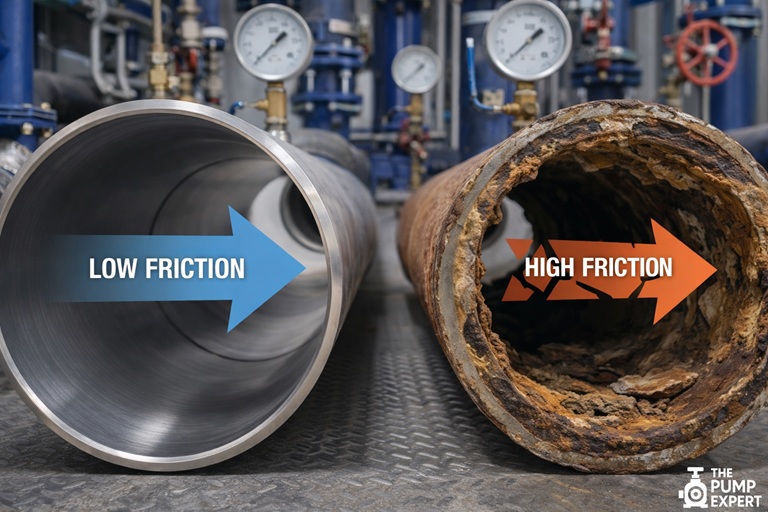
As pipework ages, corrosion, scaling, deposits, and surface wear can make the internal wall less smooth. That change increases friction loss in the system. In practical terms, the pump must generate more head to move the same flow. If the pump cannot supply that extra head, the delivered flow rate drops. If the system still demands the same duty, power consumption can rise. In some systems, the penalty can reach 10 to 20 percent or more when pipe deterioration becomes severe.
This article explains what pipe roughness is, why it matters to pump performance, how it shifts the system curve, and what maintenance teams should look for when performance declines over time.
What pipe roughness means in a hydraulic system
Pipe roughness describes the condition of the internal pipe surface that the fluid contacts as it flows through the system. A new pipe usually has a relatively smooth bore. Over time, that surface can change.
Common causes include internal corrosion, scale build-up, sediment deposition, biological fouling, abrasion, and chemical attack. In slurry or solids-handling systems, internal wear can also change the surface profile. In water and process systems, even a thin layer of scale can make a measurable difference.
Hydraulically, rougher pipe walls disturb the flow more than smooth walls. That disturbance increases resistance to flow. The result is a higher friction loss for the same flow rate.
This matters because friction loss is part of the total dynamic head the pump must overcome. Total dynamic head is the sum of static head and system losses. If pipe friction increases, total dynamic head increases as well.
Why higher roughness makes the pump work harder
A pump does not “decide” its own operating point in isolation. The actual duty point is set by the intersection of two curves:
- the pump curve, which shows the head the pump can produce at different flow rates
- the system curve, which shows the head the system requires at different flow rates
When internal pipe roughness increases, the system curve shifts upward. That means the system now needs more head at every flow rate.
If the pump speed stays the same, the operating point moves. In most centrifugal pump systems, that new duty point will usually mean lower flow and higher developed head from the pump. If the system is controlled to maintain flow, the pump may draw more power because it must overcome the added resistance.
This is why an ageing piping system can create symptoms that look like a pump problem even when the pump itself is mechanically sound.
How the system curve changes over time
The system curve is often treated as fixed, but in real plants it changes. Pipe roughness is one reason.
In a clean system, the friction component of head loss may be modest. As roughness increases, friction loss rises approximately with the square of flow in turbulent systems, but the coefficient behind that relationship also increases because the pipe wall condition has worsened. That means the whole resistance curve becomes steeper or shifts higher.
A simple way to think about it is this: the same pipeline that once needed 30 m of friction head at a given flow may later need 35 m, 40 m, or more for that same flow. The pump has not changed, but the system demand has.
In a plant that measures only pump discharge pressure and motor current, this change can go unnoticed for a long time. Operators may see lower throughput or a gradual increase in energy use without identifying the hydraulic cause.
Common signs that roughness is affecting performance
Pipe roughness usually does not create a sudden failure. It creates a slow drift in performance. That makes it easy to miss during routine troubleshooting.
Typical signs include:
- gradual reduction in delivered flow rate
- increasing pump power consumption for the same process output
- higher differential pressure across the pump with no improvement in flow
- reduced margin between normal operation and low-flow or recirculation conditions
- more frequent complaints that “the pump used to perform better” even though inspection finds no major internal pump damage
These symptoms are especially common in older cooling water, process water, fire water, mine water, and chemical transfer systems where the piping has been in service for years.
The key point is that a pump can appear underperforming when the real problem is that the system resistance has increased.
Why this is often overlooked in troubleshooting
There are three main reasons.
First, pipe roughness is gradual. Teams adapt to the decline without noticing the original baseline has changed.
Second, many troubleshooting routines focus on the pump and motor first. That makes sense because those assets are easier to inspect directly than buried or insulated pipework.
Third, plants do not always maintain good historical hydraulic data. If there is no record of original flow, head, pipe condition, and power draw, it becomes difficult to prove that the system curve has shifted.
The result is predictable. A pump may be blamed for low flow when the real cause is increased friction loss in the line. In some cases, the response is to trim controls, increase speed, or replace the pump with a larger unit. That may recover performance, but it does not solve the underlying hydraulic deterioration.
A practical example
Consider a centrifugal pump that originally delivered 100 m³/h at the required head in a relatively clean piping system. Over several years, internal scaling and corrosion increase the effective roughness of the discharge line and key fittings.
The system now imposes more friction loss at 100 m³/h than it did when commissioned. If the pump curve remains unchanged, the duty point moves left along the pump curve. Instead of 100 m³/h, the pump may now deliver 90 or 85 m³/h.
In another case, a Variable Frequency Drive (VFD) may increase speed to hold target flow. That keeps production stable, but energy use rises because the pump is doing more hydraulic work. Operators may only notice the issue when the motor load approaches its limit or when energy costs become harder to ignore.
A 10 to 20 percent increase in power demand is entirely plausible in systems with significant internal deterioration, especially where pipe runs are long or friction losses already make up a large share of total head.
Where roughness has the biggest impact
The effect is most significant where friction losses are already a major part of the duty. That typically includes:
- long pipe runs
- smaller diameter pipework with higher velocities
- systems with many fittings, bends, and valves
- recirculating systems that operate continuously
- older systems exposed to corrosion, scaling, or solids deposition
In a system dominated by static lift, pipe roughness may still matter, but the relative impact can be smaller. In a friction-dominated system, a modest increase in internal resistance can materially change the duty point.
That is why two similar pumps can show very different long-term behaviour depending on the piping system they serve.
How to check whether pipe roughness is the problem
The best approach is to compare current operating data with the original design or commissioning condition.
Start with flow rate, suction pressure, discharge pressure, fluid properties, pump speed, and motor power. Compare those figures with the pump curve and the expected system duty. If the pump appears healthy but the operating point has shifted, rising system resistance is a likely cause.
Then review the pipe history. Look for age, material, service fluid, corrosion risk, scaling tendency, solids content, and any known fouling issues. Inspection records, removed spool pieces, filter debris, and maintenance observations can all help.
Useful checks include:
- trending power versus flow over time
- comparing current pressure loss across known pipe sections or heat exchangers
- inspecting representative pipe samples during shutdown
- checking whether valve positions have gradually changed to compensate for declining performance
- recalculating the system curve using updated roughness assumptions
This is often enough to distinguish a piping problem from a pump problem.
What to do about it
The right response depends on the cause of the roughness increase.
If the issue is scaling or fouling, cleaning may restore much of the original hydraulic performance. If internal corrosion is severe, replacement of affected sections may be more realistic. In abrasive services, material selection and velocity control may need review to slow future wear.
It is also worth checking whether the current operating point still aligns with the pump’s preferred operating region. When the system curve shifts, the pump may move away from its best efficiency point. That can reduce efficiency, increase vibration risk, and shorten component life.
The important lesson is to treat pipework as part of the hydraulic machine. The pump, valves, fittings, and piping all determine performance together.
Pipe condition should be part of every pump performance review
When flow drops or energy use rises, the pump is not always the root cause. Internal pipe roughness can quietly increase system friction over months or years, shifting the duty point and reducing performance.
This effect is easy to overlook because it develops slowly and often sits outside routine pump inspections. But in many systems, it is one of the most important reasons performance changes over time.
A sound troubleshooting process should always ask one system-level question: has the hydraulic resistance of the pipework changed since the pump was commissioned?
That question often leads to better diagnosis, better maintenance decisions, and better energy performance.
Key takeaways
- Pipe internal roughness increases over time due to corrosion, scaling, deposits, fouling, and wear.
- Higher roughness increases friction loss, so the system requires more head at the same flow rate.
- As the system curve shifts upward, a centrifugal pump will usually deliver less flow unless speed or power input increases.
- In severe cases, increased friction losses can raise power consumption or reduce delivered flow by 10 to 20 percent or more.
- Gradual hydraulic deterioration is often mistaken for pump wear or pump underperformance.
- Effective troubleshooting should compare current operating data with the original system condition, not just inspect the pump.
Last Updated on April 1, 2026 by TPE
