
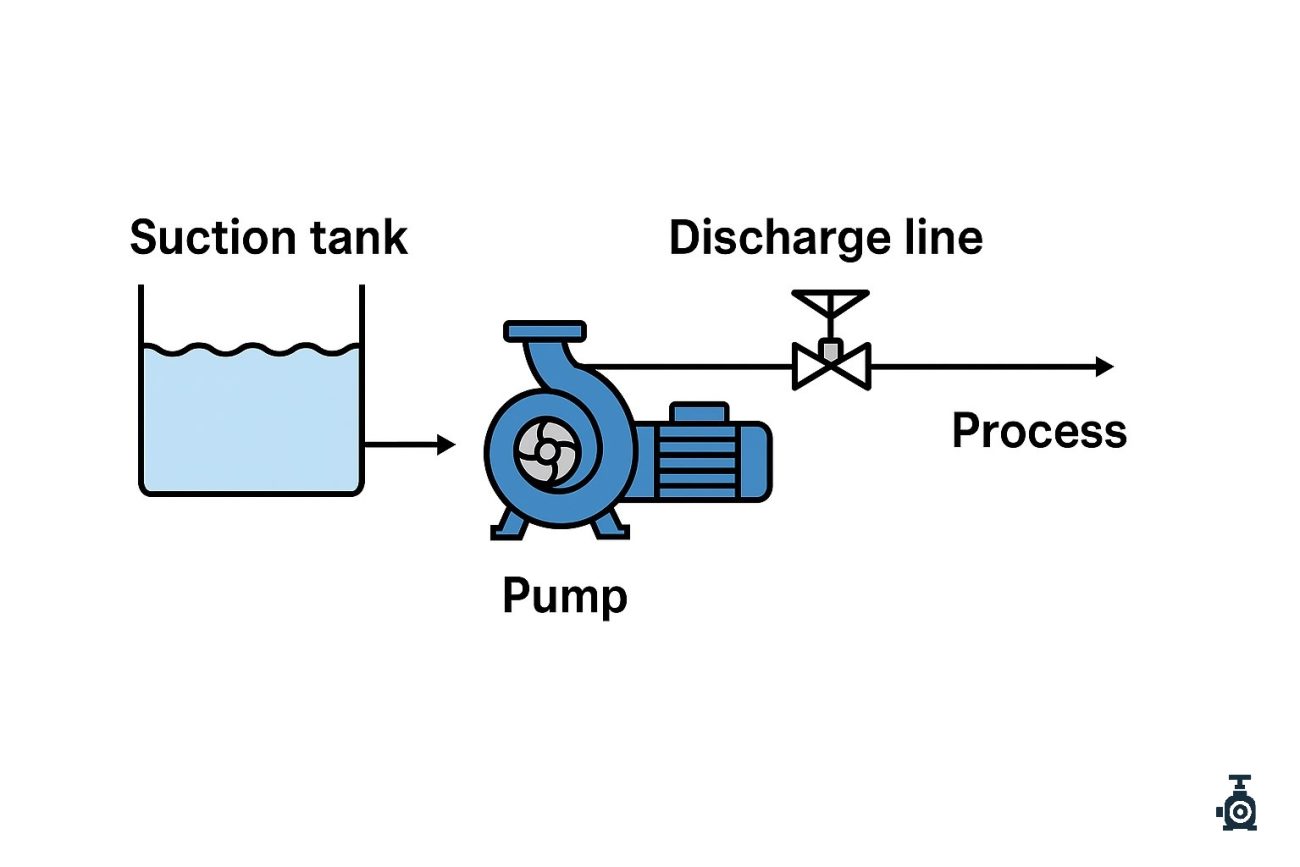
When most people start learning about pumps, they focus on the pump itself — the impeller, the casing, the motor, the curves, how it works etc.
But here’s the truth: you’ll never truly master pumps by studying them in isolation.
You master pumps by understanding the system they will live in.
Because no matter how well-designed or expensive a pump might be, its performance, reliability, and efficiency all depend on the environment it operates in — the piping, the layout, the controls, and the process it’s part of.
A Pump Is Only as Good as Its System
Think of it this way:
You can select the best pump for the job, but if the suction conditions are poor, or if the discharge line is oversized, or the control valve is constantly throttled — performance suffers.
Flow, pressure, layout, control — everything is connected.
A small change in one part of the system can ripple through the entire process, creating issues like vibration, cavitation, or premature wear.
That’s why so many real-world pump failures aren’t pump failures at all — they’re system failures.
The Problem With How We Teach Pumps
Most traditional pump training focuses on the pump alone:
- How it works
- How to read the curve
- How to select a model
That knowledge is important — but it’s not enough.
Real-world performance doesn’t come from theory or specs on paper. It comes from understanding how the pump interacts with tanks, valves, piping, and process conditions. In short — the whole system.
Why System Thinking Matters
When you understand systems, you can see problems before they happen.
You can look at a layout and instantly spot where NPSH might be marginal, or where air pockets could form in suction lines.
You can predict where inefficiencies will creep in and correct them before they turn into downtime.
That’s not just technical skill — that’s engineering intuition.
And it only comes from thinking in systems.
Training the Right Way
At The Pump Expert, we believe pump education should reflect how pumps really behave in the field — as part of a connected system.
That’s why our approach goes beyond theory and specs.
We focus on helping engineers, operators, and maintenance teams think in systems — to diagnose problems, optimise layouts, and prevent failures before they start.
Because in the pump industry, system knowledge isn’t optional.
It’s the difference between short-term fixes and lasting performance.
Key Takeaway
You don’t master pumps by memorising data sheets.
You master them by understanding how every component — suction, discharge, valves, controls, and process — fits together.
That’s where reliability begins.
And that’s what turns a pump operator into a pump expert.
