
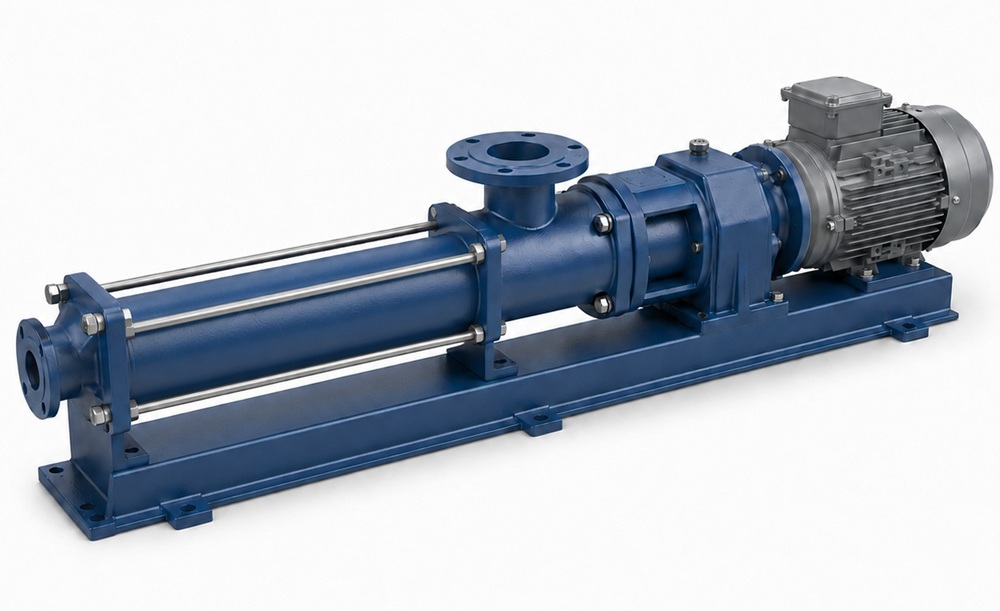
Progressive cavity pumps are often selected when a centrifugal pump struggles with viscous fluids, entrained solids, low shear requirements, or flow stability. They can be excellent pumps in the right duty. They can also be expensive, short-lived, or awkward to maintain when applied poorly.
This article explains where progressive cavity pumps perform well, where they need caution, and what engineers should check before specifying one.
How a progressive cavity pump works
A progressive cavity pump is a positive displacement pump. A helical rotor turns inside a double-helix elastomer stator. As the rotor turns, sealed cavities form and progress from the suction side to the discharge side.
Each cavity carries a fixed volume of fluid. This gives the pump a near-constant flow rate for each revolution, assuming the cavities remain sealed and the fluid does not slip excessively through internal clearances.
That operating principle gives progressive cavity pumps several useful traits:
They can move thick fluids that do not flow easily.
They can handle soft solids without high impact forces.
They produce a smoother flow than many other positive displacement pumps.
They can meter fluid accurately when speed is controlled correctly.
The same design also creates limitations. The rotor and stator remain in close contact. That contact is essential for sealing, but it also creates friction, wear, heat, and chemical compatibility concerns.
Where progressive cavity pumps perform well
Viscous fluids
Progressive cavity pumps are strong candidates for viscous fluids. Viscosity describes a fluid’s resistance to flow. Water has low viscosity. Thick sludge, polymer solution, molasses, heavy oil, paste, and dewatered slurry have higher viscosity.
Centrifugal pumps lose efficiency quickly as viscosity rises. Their impellers depend on velocity transfer, and thick fluids absorb that energy poorly. Progressive cavity pumps displace a fixed volume per revolution, so they can maintain flow more predictably as viscosity increases.
This makes them useful for:
- wastewater sludge
- lime slurry
- food pastes
- polymer dosing
- thickened tailings
- oily waste
- resin and adhesive transfer
The suction side still matters. Highly viscous fluids may not enter the cavities fast enough if suction pipework is undersized, too long, or poorly arranged. Low pump speed, short suction lines, and flooded suction often improve reliability.
Fluids with soft solids
Progressive cavity pumps can handle fluids containing solids because the cavities are relatively large and move gently through the pump. They suit soft or deformable solids better than hard, sharp, or abrasive particles.
Examples include biological sludge, fruit pieces, fibrous process waste, and some slurry streams.
The key word is “suitability”, not immunity. Abrasive solids wear the stator and rotor. Large hard particles can damage the elastomer or jam the pump. Long fibres can wrap around the rotor or bridge at the inlet.
Before selecting the pump, check:
- maximum particle size
- solids concentration
- particle hardness
- fibre length
- abrasiveness
- inlet geometry
A large solids content may also require an enlarged inlet, bridge breaker, or hopper arrangement.
Low shear duties
Shear is the mechanical stress that deforms or breaks down a fluid, particle, or product structure. Some fluids are shear-sensitive. Examples include polymer solutions, flocculated sludge, emulsions, yeast slurry, creams, and some food products.
Progressive cavity pumps generate lower shear than many high-speed centrifugal pumps because they operate at lower speeds and move fluid through enclosed cavities rather than through a fast impeller.
This helps when the process needs to preserve:
- polymer chain length
- floc structure
- product texture
- emulsion stability
- biological material
Low shear does not mean zero shear. Shear still occurs at the rotor-stator interface, at restrictions, and in pipework. Pump speed, pressure, viscosity, and system layout all affect the final result.
Metering and flow control
Progressive cavity pumps can provide accurate metering because flow is roughly proportional to speed. When paired with a Variable Frequency Drive (VFD), the pump can vary output by changing rotational speed.
This suits chemical dosing, polymer make-up systems, additive injection, and controlled feed duties.
Accuracy depends on several factors:
- stator condition
- differential pressure
- fluid viscosity
- internal slip
- rotor speed
- calibration
- suction stability
Internal slip is fluid leaking backward through the sealing lines inside the pump. Slip usually increases as discharge pressure rises and viscosity falls. For precise dosing, the pump should be calibrated under real operating conditions, not only against a nominal displacement value.
Low pulsation flow
Progressive cavity pumps generally produce lower pulsation than many reciprocating positive displacement pumps. The cavities progress continuously, so the discharge flow is smoother.
This can reduce vibration, pressure spikes, and flow fluctuation in sensitive systems. It can also help downstream instruments, spray systems, dosing points, and process controls work more consistently.
However, poor installation can still create pressure fluctuations. Long pipe runs, undersized discharge lines, air pockets, blocked valves, and sudden restrictions can all create unstable operation.
Where progressive cavity pumps need caution
Dry running can destroy the stator
Dry running is one of the main failure risks. The elastomer stator relies on the pumped fluid for lubrication and cooling. If the pump runs without fluid, friction between the rotor and stator generates heat quickly.
The result can be:
- stator burning
- elastomer swelling or cracking
- loss of sealing
- reduced flow
- high starting torque
- complete pump seizure
Dry-run protection is often essential. Common methods include temperature monitoring, pressure monitoring, flow detection, level control, motor load monitoring, or control logic that prevents operation without confirmed feed.
Do not rely on operators noticing the problem in time. Stator damage can occur quickly.
Stator wear is part of the operating cost
The stator is a wear component. Its life depends on fluid properties, pressure, speed, temperature, solids, chemical compatibility, and duty cycle.
Abrasive slurry shortens stator life. High pressure increases contact load. High speed increases wear rate. Poor suction conditions can cause starvation, heat, and accelerated damage.
Signs of stator wear include:
- reduced flow at the same speed
- higher slip
- loss of dosing accuracy
- reduced pressure capability
- increased leakage past cavities
- higher energy use for the same duty
For critical duties, maintenance teams should trend speed, flow, pressure, and motor load. A gradual increase in speed required to maintain flow often points to wear or changing fluid conditions.
Chemical compatibility matters
The stator material must suit the fluid. Elastomers can swell, harden, soften, crack, or lose strength when exposed to incompatible chemicals.
Chemical compatibility depends on:
- fluid composition
- concentration
- temperature
- exposure time
- cleaning chemicals
- pH
- hydrocarbons or solvents
- oxidising agents
Compatibility checks should include the normal process fluid and any clean-in-place, flush, or sterilisation chemicals. A stator that suits the product may fail during cleaning if the cleaning chemical attacks the elastomer.
They can have a large footprint
Progressive cavity pumps are often longer than other pump types because the rotor and stator form an extended pumping element. Maintenance space can also exceed the installed footprint.
This matters in pump rooms, packaged skids, wastewater galleries, and retrofit projects.
Check the space needed to:
- remove the rotor
- replace the stator
- access coupling guards
- remove drive components
- lift heavy parts safely
- align the drive after maintenance
A pump that fits on paper may still be difficult to maintain in the field.
Maintenance access can make or break reliability
Progressive cavity pumps need periodic inspection and wear-part replacement. If access is poor, maintenance takes longer and operators may delay necessary work.
Common access problems include:
- no room to pull the rotor
- pipework blocking the stator
- coupling guards that are hard to remove
- insufficient lifting points
- no isolation valves
- no drain points
- poor access to the mechanical seal or packed gland
Good installation design reduces lifetime cost. Include isolation valves, drain points, lifting access, removable pipe spools, and enough straight-line withdrawal space.
They are not ideal for every fluid
Progressive cavity pumps are poor choices for some services.
They usually do not suit clean, low-viscosity fluids at high pressure if another pump type can perform the duty more efficiently. They may also struggle with highly abrasive slurry, aggressive chemicals, very high temperatures, or fluids that dry, cure, or set inside the pump.
A blocked discharge is also dangerous. Positive displacement pumps continue to generate pressure until something relieves the load or fails. A pressure relief path is essential.
Progressive cavity pump selection checklist
Before selecting a progressive cavity pump, confirm:
| Selection factor | Why it matters |
|---|---|
| Viscosity range | Affects suction filling, speed, torque, and flow stability |
| Solids size and hardness | Determines wear risk and inlet design |
| Shear sensitivity | Supports low-speed pump selection |
| Required flow accuracy | Determines calibration and control needs |
| Differential pressure | Affects slip, torque, and stator load |
| Chemical compatibility | Determines stator and seal material suitability |
| Dry-run risk | Determines protection requirements |
| Maintenance space | Determines whether the pump can be serviced safely |
| Cleaning method | Confirms compatibility with washdown or cleaning chemicals |
Key takeaways
- Progressive cavity pumps suit viscous fluids, soft solids, low shear duties, and controlled metering.
- They can provide smoother flow than many reciprocating positive displacement pumps.
- Dry running can rapidly damage the stator, so protection is often necessary.
- Stator wear is expected and should be managed through monitoring and planned maintenance.
- Chemical compatibility must include process fluid and cleaning chemicals.
- Maintenance access and footprint should be checked before installation, not after commissioning.
Last Updated on June 1, 2026 by TPE
