
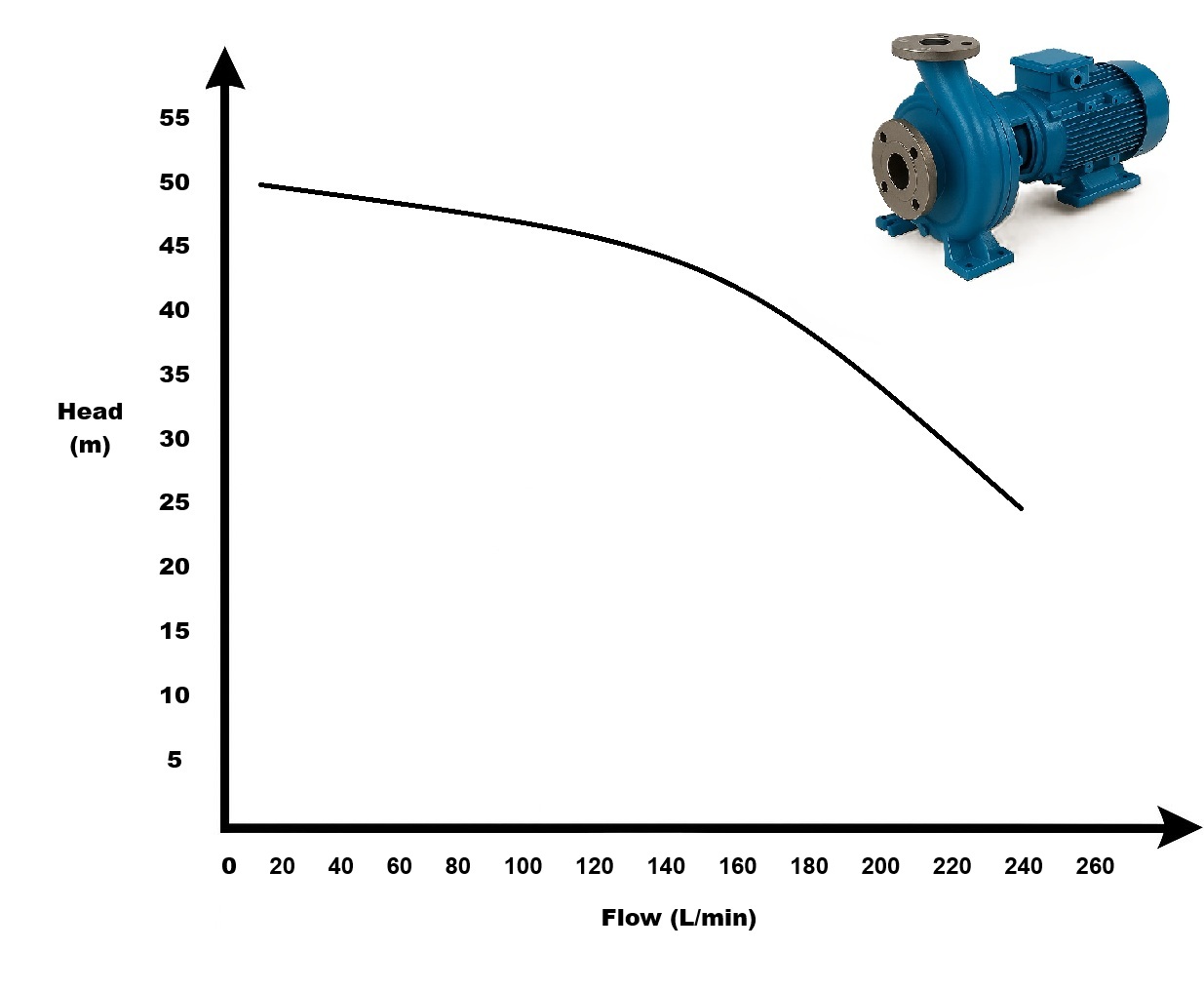
One of the most common misunderstandings in pump systems is the idea that increasing pump head automatically increases flow rate.
It sounds logical at first. More head sounds like more power, and more power sounds like more flow. But centrifugal pumps do not work that way.
In reality, higher head usually means lower flow on a given pump curve.
Understanding this relationship matters because many pump selection mistakes start with incorrect assumptions about head and flow. These mistakes can lead to oversized pumps, unstable operation, high energy use, seal failures, and poor system performance.
This article explains:
- what pump head actually means
- how head and flow relate on a pump curve
- why increasing system resistance reduces flow
- where the misconception comes from
- how to interpret pump performance correctly
What pump head actually means
Pump head is a measure of the energy the pump adds to the fluid.
More specifically, head represents the height a pump can theoretically raise a fluid column. It is normally expressed in metres.
Head is not the same thing as flow rate.
- Head = pressure energy added to the fluid
- Flow rate = volume of fluid moving through the system over time
A centrifugal pump produces a relationship between these two values. As flow changes, the available head changes too.
This relationship appears on the pump curve.
Understanding the pump curve
A pump curve shows how a specific pump performs across a range of flow rates.
For a standard centrifugal pump:
- flow decreases as head increases
- head decreases as flow increases
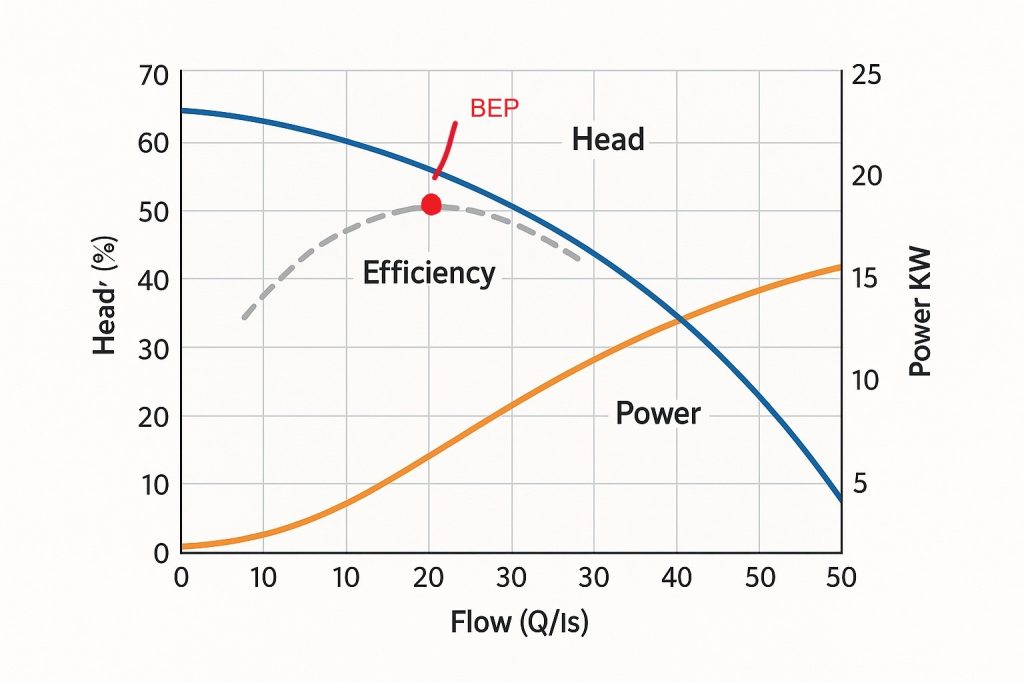
The curve slopes downward from left to right.
This simplified relationship reflects the basic behaviour of centrifugal pumps.
At shut-off conditions, the pump produces maximum head with almost zero flow.
At maximum flow conditions, the pump produces much lower head.
The pump cannot independently produce maximum head and maximum flow at the same time.
That is one of the most important concepts in pump engineering.
Why higher system head usually reduces flow
A pump does not decide flow rate on its own.
The piping system also matters.
Every system has resistance caused by:
- pipe friction
- valves
- bends and fittings
- filters and strainers
- elevation changes
This resistance is represented by the system curve.
As system resistance increases, the operating point moves to a lower flow rate.
Example
Imagine a centrifugal pump operating at:
- 80 m³/h at 20 m head
Now a discharge valve is partially closed.
The system resistance increases. The pump now operates at:
- 55 m³/h at 32 m head
The head increased.
The flow decreased.
The pump is working against greater resistance, so the operating point shifts left on the curve.
This is the opposite of the “higher head equals higher flow” assumption.
Where the misconception comes from
There are several reasons this myth persists.
Confusing pressure with flow
People often associate higher pressure with more output.
In many everyday situations, stronger pressure feels like more flow. A garden hose is a common example.
But industrial pump systems are more complex. Pressure and flow are related, but they are not interchangeable.
A pump can generate high pressure while delivering very little flow.
Misunderstanding pump datasheets
Pump curves are sometimes interpreted incorrectly.
Someone may look at a larger pump with a higher head rating and assume it must also produce more flow in every situation.
In reality, the operating point depends on where the system curve intersects the pump curve.
A higher-head pump can actually produce lower flow if the system conditions require it.
Positive displacement pumps behave differently
Some confusion also comes from comparing centrifugal pumps with positive displacement pumps.
Positive displacement pumps attempt to move a fixed volume per cycle regardless of pressure. Flow remains relatively constant unless slip or relief conditions occur.
Centrifugal pumps behave differently. Their flow changes continuously with system resistance.
The myth usually appears when people apply positive displacement thinking to centrifugal pumps.
The operating point controls real performance
A pump never operates at an arbitrary point on its curve.
The actual operating condition is where:
- the pump curve
- and the system curve
intersect.
This is called the duty point.
Hpump=Hsystem
If the system resistance increases:
- head requirement rises
- flow rate falls
If the system resistance decreases:
- flow rate rises
- developed head falls
The pump automatically settles at the new operating point.
This is why throttling a discharge valve reduces flow while increasing discharge pressure.
What happens when operators chase more flow incorrectly
Misunderstanding head and flow relationships often leads to poor operational decisions.
Oversizing pumps
A common mistake is selecting a pump with excessive head “for extra flow capacity”.
The result may be:
- operation far from Best Efficiency Point (BEP)
- recirculation
- vibration
- seal and bearing wear
- higher power consumption
Excessive throttling
Operators sometimes throttle discharge valves heavily to control flow because the installed pump produces too much capacity.
This wastes energy because the pump generates excess head that the valve converts into friction loss.
Unstable system operation
Incorrect assumptions about head can also create unstable control behaviour, especially in systems with:
- Variable Frequency Drives (VFDs)
- parallel pumps
- changing process demand
Without understanding the pump curve properly, operators may unintentionally push the pump into inefficient or damaging operating regions.
When higher head can increase flow
There is one important nuance.
If the pump itself changes — for example by increasing speed or impeller diameter — the pump curve shifts.
In that case, both head and flow may increase together.
This often causes confusion.
For example:
- increasing pump speed raises available head
- the higher-energy curve may intersect the system curve at a higher flow rate
But this does not mean “head creates flow”.
It means the pump performance curve changed.
The distinction matters.
The original myth assumes that increasing head within the same system and same pump operating curve automatically increases flow. That assumption is incorrect.
A better way to think about pump performance
Instead of thinking:
“More head equals more flow”
Think:
“Flow depends on the balance between pump energy and system resistance.”
That is how centrifugal pump systems actually behave.
Head is not a standalone measure of performance. A pump producing very high head at low flow may be operating inefficiently or even near shut-off conditions.
The full pump curve — together with the system curve — tells the real story.
Key takeaways
- Head and flow are related, but they are not the same thing.
- On a centrifugal pump curve, higher head usually means lower flow.
- Increasing system resistance shifts the operating point to lower flow and higher head.
- The duty point is determined by the intersection of the pump curve and system curve.
- Higher pump speed or larger impeller diameter can increase both head and flow because the pump curve changes.
- Misunderstanding head and flow relationships can lead to oversized pumps, wasted energy, and reliability problems.
