
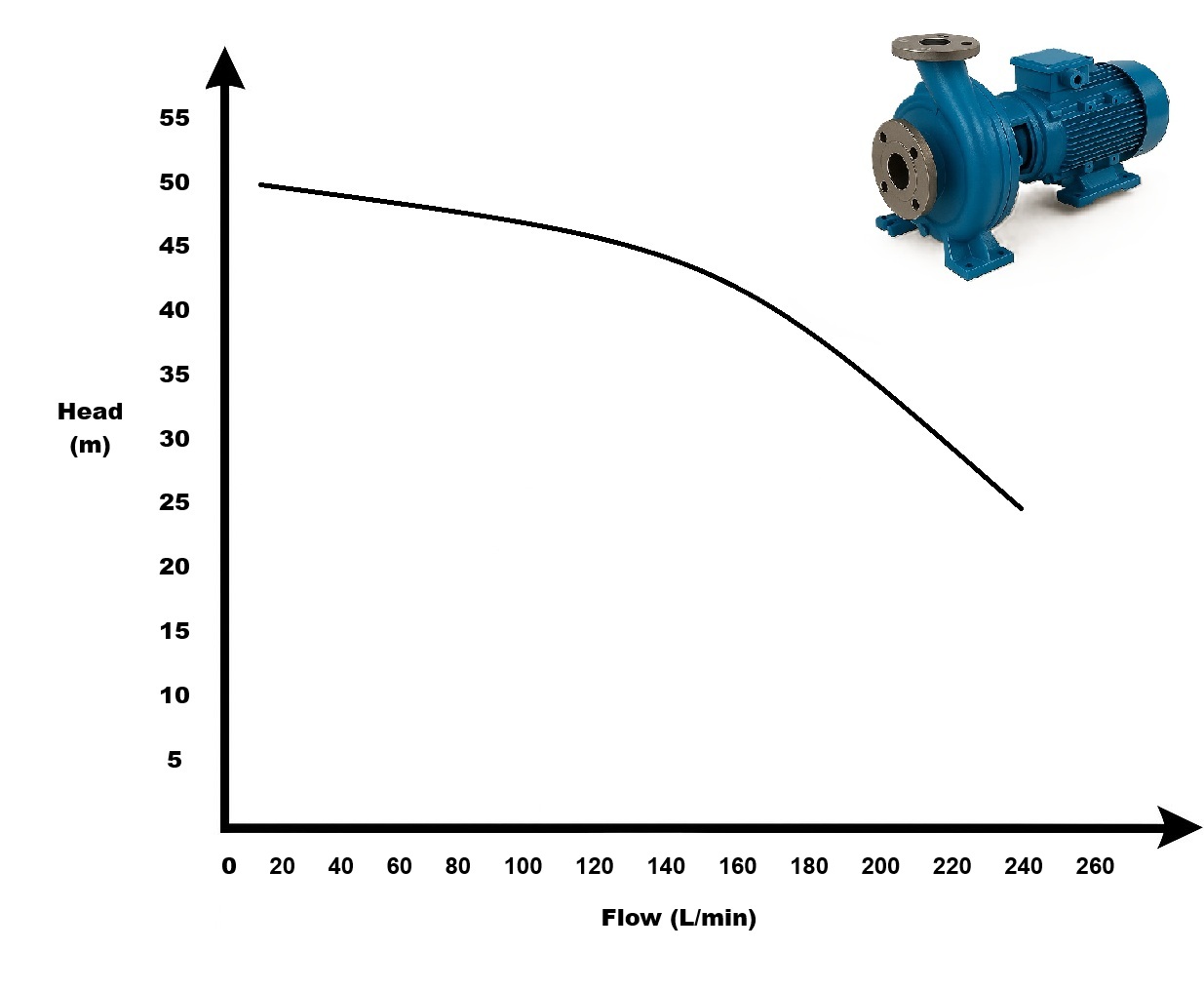
“Perfect, I’ll take that. I only need it to do 200 L/min at 45 m — so it’s well within scope!”
We’ve all heard this before.
An online listing shows Max Flow: 240 L/min and Max Head: 50 m — and suddenly it looks like the perfect match.
Sadly, this still happens today.
The Problem with Max Values
Selecting a pump based on its maximum flow or maximum head is one of the most common mistakes in the industry.
Those numbers are the extremes of the pump’s performance curve — not its normal working range. In fact, a pump operating near those limits will almost always be running far from its Best Efficiency Point (BEP), which can quickly lead to trouble.
What Can Go Wrong?
When you size or select a pump purely off the max values, you risk:
- Poor efficiency – higher power use and operating costs
- Shortened service life – due to excessive wear or stress
- Cavitation or vibration – caused by unstable flow conditions
- Inconsistent performance – the pump never seems to “hit the numbers” you expect
Over time, these issues don’t just waste energy — they damage equipment and create ongoing maintenance headaches.
What You Should Do Instead
Pump selection should always start with the duty point — the actual flow and head that your system needs to operate at.
From there, you look at the pump curve to find where that duty point sits. Ideally, it should be close to the BEP, where the pump runs at its most efficient, stable and reliable condition.
That’s where you’ll get the longest lifespan, the lowest maintenance, and the performance the manufacturer intended.
The Bottom Line
Online specs can be useful for quick comparisons — but they don’t tell the full story. A pump’s max flow or max head values are like the top speed on a car’s speedometer: impressive, but not what you will always get.
Always look for the duty point — that’s where pump selection really begins.
Last Updated on October 30, 2025 by TPE
