

Pump cavitation is one of the most destructive problems you can face in pumping systems. Left unchecked, it can shorten pump life, reduce efficiency, and cause catastrophic damage to impellers, casings, and seals. The good news? With the right design choices and operating practices, cavitation is entirely preventable.
In this article, we’ll look at what cavitation is, why it happens, and the best strategies to stop it before it starts.
What is Cavitation?
Cavitation occurs when the pressure in a liquid drops below its vapour pressure, causing tiny vapour bubbles to form. As these bubbles travel into higher-pressure regions of the pump, they collapse violently against metal surfaces. This implosion chips away material, leaving pitted impellers and eroded casings.
Signs of cavitation include:
- Unusual noise (like gravel or marbles rattling in the pump)
- Excessive vibration
- Reduced flow or head
- Rapid wear of impellers, seals, or bearings
Common Causes of Cavitation
Cavitation usually comes down to one of two things: insufficient Net Positive Suction Head (NPSH) or poor system design. Some typical causes include:
- Suction lift too high (pump located above the fluid source)
- Inlet pipe too long, too small, or restricted
- Blocked or clogged strainers/filters
- Fluid temperature too high, lowering vapour pressure
- Pump operating far from its Best Efficiency Point (BEP)
How to Prevent Cavitation
Here are proven steps to minimise the risk of cavitation in your pumping system:
1. Ensure Adequate NPSH
- Always check the pump’s NPSHr (Net Positive Suction Head required) against your system’s NPSHa (Net Positive Suction Head available).
- A good rule of thumb: keep NPSHa at least 0.5–1.0 m greater than the pump’s NPSHr.
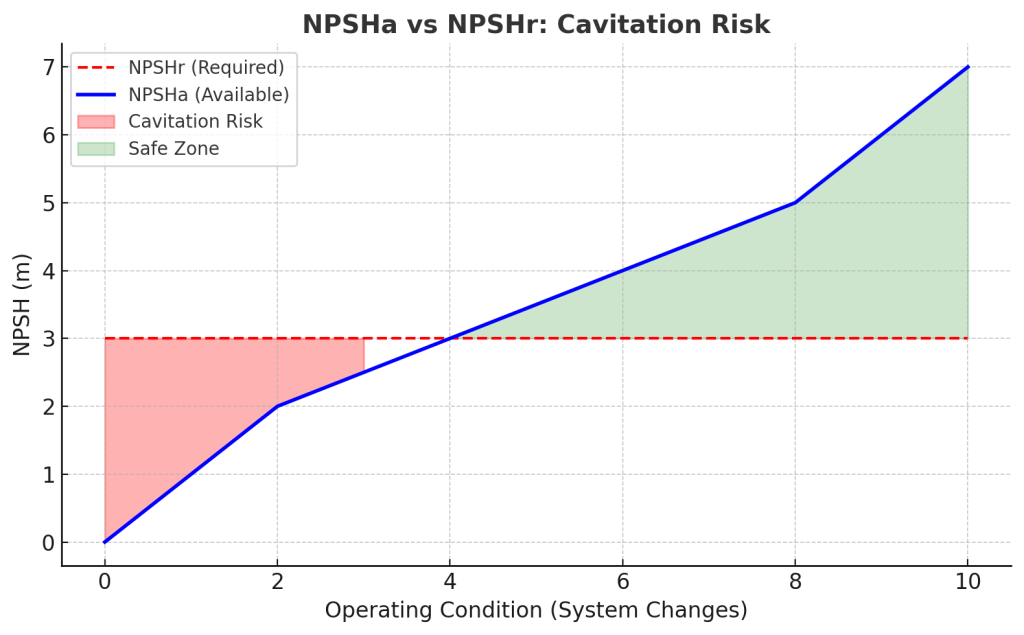
- Red dashed line (NPSHr – Required):
This is the minimum Net Positive Suction Head that the pump needs to operate without cavitation. It’s a fixed requirement defined by the pump manufacturer. - Blue solid line (NPSHa – Available):
This shows the actual suction conditions provided by your system (taking into account suction lift, pipe friction, fluid temperature, etc.). NPSHa will vary depending on how the system is set up and operated. - Green shaded zone (Safe):
Wherever the blue line (NPSHa) is above the red line (NPSHr), the pump has enough suction pressure to prevent cavitation. - Red shaded zone (Cavitation Risk):
Wherever the blue line (NPSHa) drops below the red line (NPSHr), the pump is starved of pressure. Here vapour bubbles form and collapse, causing cavitation damage.
How to Read It
- If your NPSHa > NPSHr, you’re in the clear.
- If your NPSHa ≤ NPSHr, cavitation will likely occur.
- The margin matters: engineers usually recommend at least 0.5–1.0 m extra NPSHa above NPSHr as a safety factor.
This diagram is a visual way of reinforcing the golden rule:
Always keep your system’s NPSHa comfortably above the pump’s NPSHr to avoid cavitation.
2. Improve Suction Conditions
- Use a larger-diameter suction pipe to reduce friction losses.
- Keep suction piping as short and straight as possible.
- Avoid unnecessary bends, elbows, and fittings.
- Position the pump below or close to the fluid source to maintain positive suction head.
3. Control Fluid Temperature
- Prevent fluid from heating up excessively in the suction line.
- For hot liquids, consider using pressurised suction tanks or lowering tank temperature.
4. Remove Restrictions
- Regularly inspect and clean strainers, filters, and foot valves.
- Ensure valves are fully open on the suction side.
5. Operate Near the BEP
- Running pumps too far left or right of their curve increases the chance of cavitation.
- Match pump selection to your system duty – don’t oversize.
- Use variable speed drives (VSDs) to adjust performance without throttling.
6. Monitor and Maintain
- Use vibration analysis and noise monitoring to catch early signs of cavitation.
- Check suction pressure gauges regularly.
- Replace worn impellers or seals before they worsen cavitation effects.
Final Thoughts
Cavitation is often a symptom of poor design or neglected maintenance. By paying close attention to NPSH, suction conditions, and operating points, you can extend pump life, reduce downtime, and maintain peak efficiency.
Remember: prevention is always cheaper than repair. A little attention to suction conditions and pump selection goes a long way in keeping your system free from cavitation damage.
Last Updated on September 10, 2026 by TPE
