

When selecting a centrifugal pump, the impeller design plays a huge role in efficiency, reliability, and ability to handle different fluids. The three most common types—closed, semi-open, and fully open impellers—each have strengths and limitations depending on the application.
1. Closed Impellers
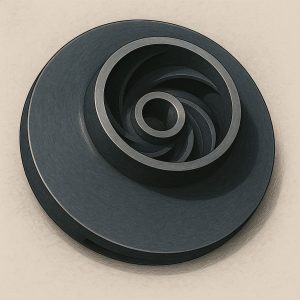
Design:
A closed impeller has vanes sandwiched between two shrouds (front and back plates). This creates fully enclosed flow passages.
Advantages:
- High efficiency due to reduced leakage and well-defined flow channels.
- Good for clean liquids such as water, chemicals, or thin oils.
- Longer wear life in clear fluid services, as the enclosed design protects vane edges.
Limitations:
- Not well suited to solids or fibrous material—clogging is more likely.
- Harder to maintain: requires full disassembly for inspection.
Common applications:
- Water supply systems
- Cooling water pumps
- Chemical transfer of clean fluids
2. Semi-Open Impellers
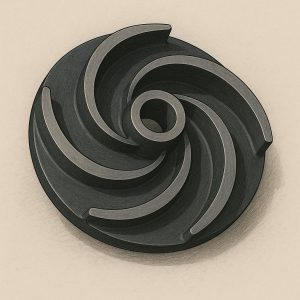
Design:
The vanes are attached to a back shroud but exposed on the front side. A wear plate or casing clearance helps maintain efficiency.
Advantages:
- Handles some solids or stringy materials better than a closed impeller.
- Easier maintenance: wear can be compensated by adjusting the clearance between impeller and casing wear plate.
- Versatile: can pump a mix of clear liquids with some suspended matter.
Limitations:
- Efficiency is generally lower than closed impellers.
- More sensitive to wear, especially in abrasive service.
- Requires careful clearance adjustment to maintain performance.
Common applications:
- Wastewater and sewage
- Slurries with fine particles
- Food and beverage processes with pulp or solids
3. Fully Open Impellers

Design:
The vanes are attached only to a central hub and are completely exposed (no shrouds). Flow passages are wide and unobstructed.
Advantages:
- Excellent solids handling: best choice when liquids contain large, fibrous, or abrasive particles.
- Easy to clean and maintain: quick inspection and clearance adjustments possible.
- Less risk of clogging thanks to wide-open passages.
Limitations:
- Lowest efficiency of the three designs.
- Faster wear rates in abrasive service.
- Requires precise clearance settings to maintain head and reduce recirculation.
Common applications:
- Slurry handling in mining and minerals
- Paper and pulp industry
- Food processing with fibrous or chunky solids
Which Impeller Should You Choose?
- Clean liquids, maximum efficiency → Closed impeller
- Liquids with some solids, balance of efficiency and solids handling → Semi-open impeller
- Slurries, fibrous or abrasive fluids, or applications where clogging is a concern → Fully open impeller
Key Takeaway
No impeller design is “better” across the board—the choice depends on fluid characteristics, solids content, required efficiency, and maintenance practices. Understanding the differences between closed, semi-open, and fully open impellers helps ensure you get a pump that not only moves the fluid, but does so reliably, efficiently, and with minimal downtime.
