
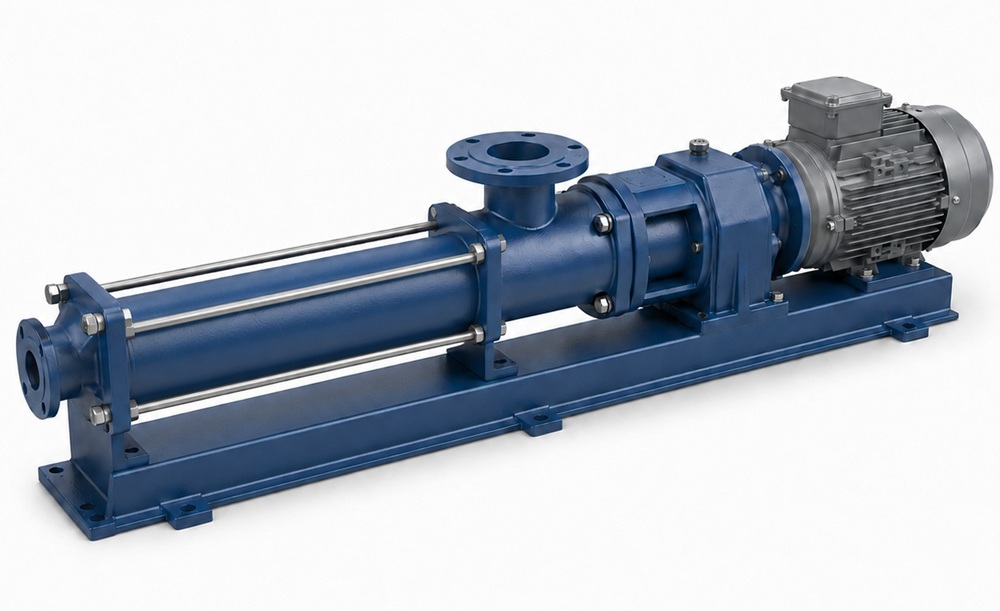
Helical rotor pumps are a type of positive displacement pump used for moving thick, viscous, abrasive, or shear-sensitive fluids.
They are also commonly called progressive cavity pumps or PC pumps. Instead of using a fast-spinning impeller, they use a helical rotor turning inside a stator to move liquid through a series of sealed cavities. This gives a steady, controlled flow that is useful in many industrial applications.
How Helical Rotor Pumps Work
A helical rotor pump uses two main pumping components:
- A metal helical rotor
- An elastomer stator
As the rotor turns inside the stator, cavities are formed between the two parts. These cavities move from the suction side of the pump to the discharge side, carrying fluid through the pump in a smooth and controlled way.
Because each rotation moves a set volume of liquid, the pump flow is generally proportional to speed. This makes helical rotor pumps useful where controlled flow or dosing is required.
Where Helical Rotor Pumps Are Used
Helical rotor pumps are commonly used for fluids that are difficult for standard centrifugal pumps to handle.
Typical applications include:
- Sludge transfer
- Wastewater treatment
- Thickened liquids
- Polymer dosing
- Food and beverage products
- Oils and greases
- Pastes and viscous fluids
- Light slurry transfer
- Chemical transfer, where materials are compatible
- Products that need gentle handling
They are often selected when the fluid is too thick, too variable, or too sensitive for a centrifugal pump.
Main Strengths of Helical Rotor Pumps
Good for viscous fluids
Helical rotor pumps are well suited to thick liquids. As viscosity increases, centrifugal pumps often lose efficiency and flow. These pumps can maintain a more predictable flow rate, provided it is correctly selected.
Steady flow
The pumping action is relatively smooth compared with many other positive displacement pumps. This makes them useful for metering, dosing, and process applications where flow consistency matters.
Gentle product handling
The low-shear pumping action can help protect sensitive products. This is useful for some food, chemical, polymer, and wastewater applications.
Can handle soft solids
Depending on the pump design, helical rotor pumps can handle some soft solids and suspended materials. This is one reason they are commonly used in sludge and wastewater applications.
Good suction capability
Helical rotor pumps can often provide strong suction performance when correctly installed and primed. However, good suction pipework design is still important.
Key Limitations
They should not run dry
Dry running is one of the most common causes of helical rotor pump damage. The rotor and stator rely on the pumped fluid for lubrication. Without fluid, heat can build up quickly and damage the stator.
Dry run protection is strongly recommended where there is any risk of the pump losing feed.
Stator wear is expected
The stator is a wear part. Its life depends on the fluid, speed, pressure, temperature, and chemical compatibility. Abrasive fluids, high pressure, poor suction conditions, and dry running can all reduce stator life.
Chemical compatibility matters
Because the stator is usually made from an elastomer, compatibility with the pumped fluid is critical. A pump may be mechanically suitable for the duty, but still fail if the stator material is not compatible with the chemical, temperature, or cleaning process.
Not always best for highly abrasive slurry
Helical rotor pumps can handle some abrasive fluids, especially when run slowly and selected correctly. However, for highly abrasive slurry, other pump types may be better depending on the duty.
They need careful selection
A helical rotor pump should not be selected from flow and pressure alone. The fluid properties are just as important.
Important Selection Questions
Before selecting a helical rotor pump, consider:
- What is the flow rate?
- What discharge pressure is required?
- What is the fluid viscosity?
- Does the viscosity change with temperature or process conditions?
- Are there solids present?
- Are the solids soft, hard, fibrous, or abrasive?
- Is the fluid shear-sensitive?
- Is the fluid chemically compatible with the stator?
- What is the fluid temperature?
- Can the pump ever run dry?
- Is the suction condition flooded, under lift, or variable?
- Is the pump being used for transfer, dosing, or process control?
The more difficult the fluid, the more important these details become.
Common Installation Issues
A helical rotor pump can be very reliable, but installation has a big impact on performance.
Common issues include:
- Starved suction
- Running the pump too fast
- Dry running
- Incorrect stator material
- Excessive discharge pressure
- Blocked or restricted suction pipework
- Poorly designed pipework
- No pressure relief protection
- No dry run protection
- Abrasive service without allowing for wear
Because this is a positive displacement pump, it should never be deadheaded unless the system has suitable pressure protection.
When a Helical Rotor Pump Is a Good Choice
A helical rotor pump may be a good choice when:
- The liquid is thick or viscous
- Flow needs to be controlled
- The product is shear-sensitive
- The fluid contains soft solids
- A steady positive displacement flow is required
- The pump needs to handle variable fluid conditions
- A centrifugal pump is struggling with the application
When It May Not Be the Best Choice
A helical rotor pump may not be the best option when:
- The liquid is clean, thin, and easy to pump
- The application is simple water transfer
- The fluid is highly abrasive
- The pump may run dry
- The chemical is not compatible with the stator
- Very high flow is required
- Low maintenance cost is more important than controlled flow
In these cases, another pump type may be more suitable.
Helical rotor pumps are excellent for controlled movement of viscous, thick, soft-solid, or shear-sensitive fluids. They provide steady flow and good suction performance, but they rely heavily on correct selection, fluid compatibility, and dry run protection.
They are not a universal pump choice. When used in the right application, they can be very effective. When used in the wrong application, stator wear, dry running, and high maintenance costs can become a problem.
Last Updated on June 30, 2026 by TPE