
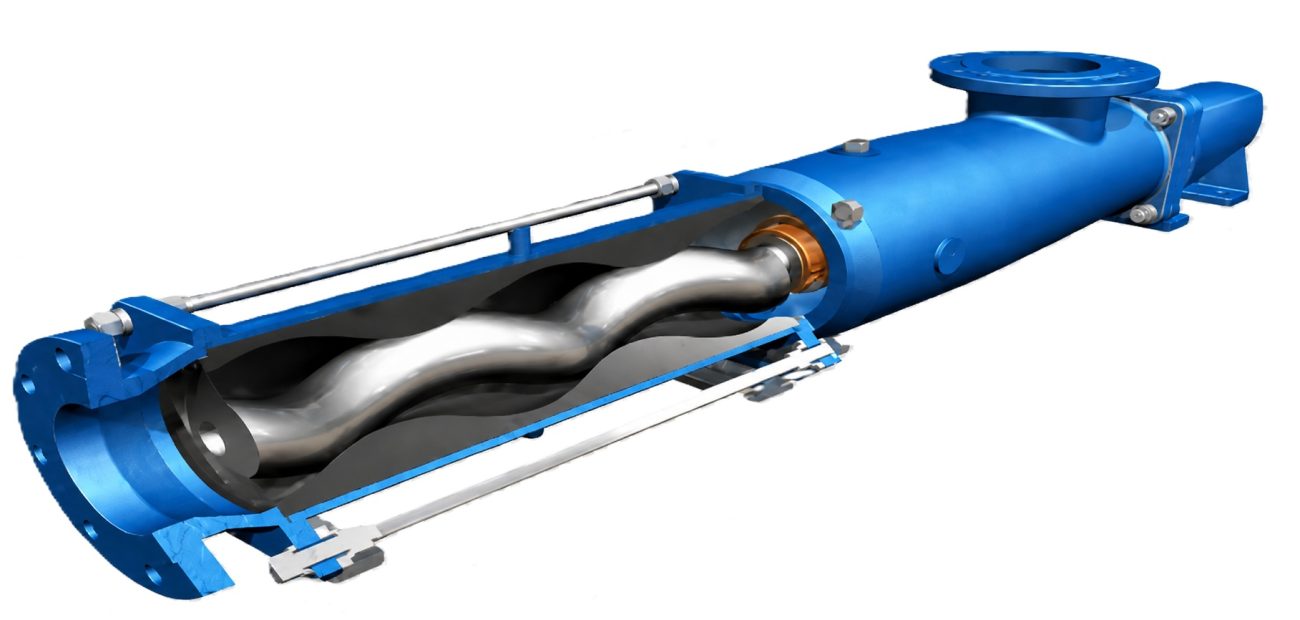
Progressive cavity pumps handle fluids that many other pump types struggle with. They can move viscous products, sludge, slurries, polymers and shear-sensitive fluids while delivering a steady, non-pulsating flow.
That capability comes with a design characteristic that operators sometimes underestimate: the rotor and stator are intended to run in continuous contact.
When a progressive cavity pump loses product and continues operating, the damage process starts immediately. Unlike some other positive displacement pumps, there is no safe period where the pump can continue running dry while operators investigate the cause.
Understanding what happens inside the pump during dry running helps explain why dry run protection is one of the most important reliability measures for this pump type.
How a progressive cavity pump normally operates
A progressive cavity pump consists of two primary hydraulic components:
- A metallic helical rotor
- An elastomeric stator with a matching internal profile
The rotor turns eccentrically inside the stator, creating a series of sealed cavities that progress from suction to discharge. These cavities transport fluid through the pump.
The sealing action relies on intentional interference between the rotor and stator. The rotor does not spin freely with a clearance gap. Instead, the elastomer stator is slightly compressed against the rotor surface.
This interference creates the seal required to generate pressure and move fluid efficiently.
Under normal operating conditions, the pumped fluid performs three critical functions:
- Lubricates the rotor-stator interface
- Removes heat generated by friction
- Helps distribute load across the sealing surfaces
The pump depends on the fluid for both hydraulic performance and mechanical survival.
Rotor and stator contact is continuous
Many pump failures occur because operators assume the rotor and stator behave like bearings separated by an oil film.
That is not how a progressive cavity pump works.
The rotor remains in continuous contact with the stator along multiple sealing lines throughout the pumping element. Friction is always present. The design accepts this friction because the pumped fluid provides lubrication and cooling.
When product disappears, the contact remains but the lubrication does not.
The rotor continues rotating against the elastomer surface at full speed. Every revolution generates frictional energy directly at the rotor-stator interface.
At this point the pump effectively becomes a friction-generating machine rather than a fluid-moving machine.
The tighter the rotor-stator fit, the faster heat generation occurs.
Heat build-up happens surprisingly fast
Dry running damage is fundamentally a heat problem.
The mechanical energy supplied by the motor has to go somewhere. During normal operation, much of that energy moves fluid through the system. The pumped liquid also removes heat from the rotor and stator.
During dry running, fluid movement largely disappears and cooling stops.
The remaining energy converts directly into frictional heat.
The stator material is particularly vulnerable because elastomers are poor conductors of heat. Heat generated at the contact surface tends to remain trapped within the rubber rather than dissipating quickly.
Field inspections often reveal that severe stator damage can occur within minutes. In some applications, measurable damage develops in less than a minute.
Several factors accelerate heat build-up:
| Factor | Effect on damage rate |
|---|---|
| Higher pump speed | Increases frictional energy generation |
| Tight rotor-stator fit | Increases contact pressure |
| Large pump size | Generates more total heat |
| High discharge pressure before dry running | Higher loading on sealing lines |
| Abrasive residue remaining in pump | Additional wear and friction |
The damage process is usually much faster than operators expect.
What happens to the stator during dry running
The stator is almost always the first major component to suffer damage.
As temperature rises, the elastomer begins to change its physical properties.
Initially, the rubber softens and loses stiffness. As temperatures continue increasing, several failure mechanisms can occur:
Thermal expansion
The elastomer expands as it heats.
This increases contact pressure between rotor and stator, which increases friction.
More friction generates more heat.
The result is a self-accelerating failure process.
Surface glazing
The stator surface can become polished and hardened.
Once glazing occurs, sealing performance deteriorates and pump efficiency drops even if catastrophic failure does not occur immediately.
Elastomer tearing
As temperatures rise further, sections of the stator may begin to tear or chunk away.
Pieces of damaged elastomer can enter downstream equipment and contaminate the process.
Permanent loss of interference
Even if the stator does not visibly fail, overheating can permanently alter its dimensions.
The pump may continue operating after product flow returns, but capacity and discharge pressure often decline because the sealing geometry has been damaged.
This is one reason why a pump that survives a dry running event may never recover its original performance.
Loss of lubrication causes more than heat
Heat receives most of the attention, but lubrication loss creates additional problems.
Under normal conditions, the fluid film reduces direct surface interaction between rotor and stator.
When that film disappears:
- Surface friction increases dramatically
- Rotor surface wear accelerates
- Stator wear accelerates
- Starting torque increases
- Power consumption can rise
- Coupling and drive components experience higher loads
The resulting damage may extend beyond the pumping element.
It is common to inspect a dry-run failure and focus on the stator while overlooking stress imposed on the drive train.
Why repeated short dry-running events are dangerous
Many operators assume that brief dry-running events are harmless because the pump continues operating afterwards.
In practice, repeated short-duration events often create significant long-term damage.
Each event can produce:
- Small amounts of thermal degradation
- Progressive hardening of elastomer surfaces
- Reduced sealing efficiency
- Accelerated wear rates
The effect is cumulative.
A stator that should last several years may fail much earlier because it experienced dozens of brief dry-running incidents that individually appeared insignificant.
When maintenance teams investigate unexpectedly short stator life, intermittent dry running is often a contributing factor.
Common causes of dry running
Dry running usually results from a system issue rather than a pump issue.
Common causes include:
- Empty supply tanks
- Blocked suction lines
- Closed isolation valves
- Loss of suction prime
- Excessive suction lift
- Bridging or rat-holing in sludge hoppers
- Air ingress on the suction side
- Instrumentation failures that provide incorrect level readings
Finding and eliminating the root cause is as important as replacing damaged components.
Why dry run protection matters
Because damage develops quickly, relying on operator intervention is rarely sufficient.
By the time unusual noise, temperature or power consumption becomes obvious, significant stator damage may already have occurred.
Dry run protection provides automatic shutdown before damaging temperatures develop.
Common protection methods include:
| Protection method | What it detects |
|---|---|
| Stator temperature monitoring | Heat build-up in the pumping element |
| Pump power monitoring | Changes in motor load |
| Flow monitoring | Loss of product movement |
| Suction vessel level monitoring | Low product availability |
| Pressure monitoring | Abnormal operating conditions |
No single protection method suits every application. The appropriate solution depends on the process, fluid characteristics and consequences of failure.
What matters is recognising that dry running is not a minor operating upset. For a progressive cavity pump, it is one of the fastest routes to expensive component damage.
Key takeaways
- Progressive cavity pumps rely on continuous rotor-stator contact to create a hydraulic seal.
- The pumped fluid provides both lubrication and cooling at the rotor-stator interface.
- Dry running removes lubrication while contact friction remains.
- Heat can build rapidly and damage the elastomer stator within minutes or even seconds in severe cases.
- Even brief dry-running events can shorten stator life through cumulative thermal damage.
- Automatic dry run protection is one of the most effective ways to prevent costly rotor and stator failures.
Last Updated on September 9, 2026 by TPE
