
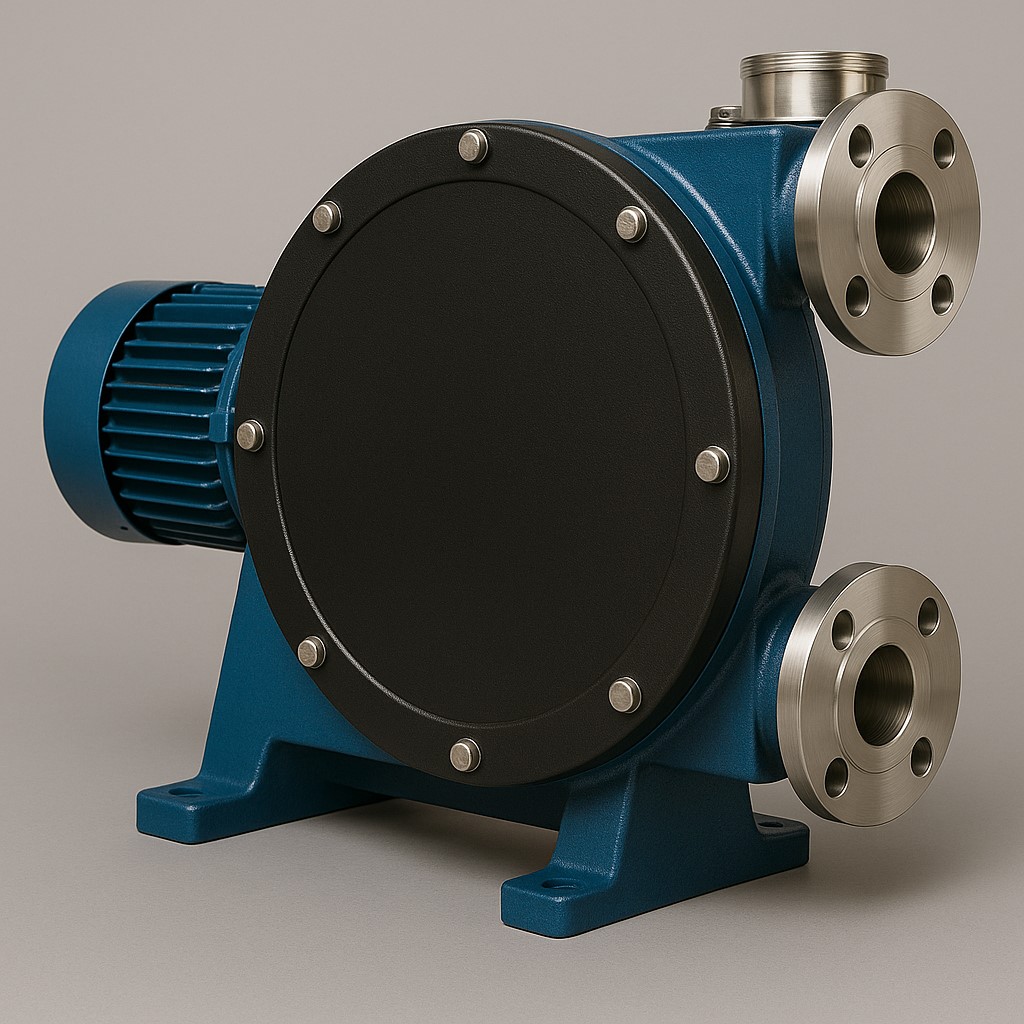
Peristaltic pumps are often used where a metering pump must dose fluids that are abrasive, dirty, viscous, chemically aggressive or prone to trapped gas. They are common in water treatment, wastewater, food and beverage, chemical dosing and industrial reuse systems.
The main attraction is the pump’s flow path. In a peristaltic pump, the fluid stays inside a flexible hose or tube. Rollers or shoes compress the hose and push a fixed volume of fluid forward. This makes the pump a type of positive displacement pump, meaning it moves a defined volume of fluid with each rotation or stroke. Positive displacement pumps are widely used for metering because flow can be controlled by speed and displacement, and is less affected by changing suction and discharge conditions than centrifugal pump flow.
The linked source article frames this around metering applications where the pump may need to handle dirty fluids, trapped gases, brewery wastewater and reuse water, while also stressing the importance of proper maintenance.
How a peristaltic pump meters fluid
A peristaltic pump works by squeezing a flexible hose or tube against the pump casing. As the rotor turns, the compression point travels along the hose. Fluid ahead of the compression point moves toward the discharge. When the hose opens behind the roller or shoe, it creates a suction effect that draws more fluid into the pump.
For metering duties, this matters because each rotor movement displaces a repeatable volume of fluid. Flow rate is usually adjusted by changing pump speed, tube size, stroke setting or control signal, depending on the pump design.
This makes peristaltic pumps suitable for proportional dosing, batch dosing and low-to-moderate flow chemical injection. They are especially useful where the process needs repeatable dosing rather than high hydraulic efficiency.
Why peristaltic pumps suit difficult metering fluids
Peristaltic pumps solve several practical problems found in metering systems.
The fluid only contacts the hose or tube bore. This limits wetted parts and reduces the number of components that need chemical compatibility checks. In many pump types, valves, diaphragms, seals, O-rings and internal chambers all contact the fluid. With a peristaltic pump, compatibility usually centres on the hose or tube material.
They also have no internal check valves in the pumped fluid path. This can help when dosing fluids with suspended solids, crystals, grit or biological material. In some metering pumps, valves can stick, clog or lose sealing performance when solids or gas are present. A peristaltic pump avoids that specific failure point.
Positive displacement pumps also tend to handle viscous fluids differently from centrifugal pumps. Hydraulic Institute guidance notes that positive displacement pumps move volume by displacement each shaft revolution, and their volumetric efficiency can improve as viscosity reduces internal slip.
Common applications
| Application | Why peristaltic metering can help | Design check |
|---|---|---|
| Wastewater chemical dosing | Handles dirty fluids, gas pockets and intermittent operation | Confirm hose compatibility and discharge pressure |
| Brewery or food wastewater | Handles variable solids and organic loading | Check cleanability and tube change frequency |
| Reuse water treatment | Suitable for dosing oxidants, coagulants or pH correction chemicals | Verify chemical compatibility and dosing accuracy |
| Slurry or abrasive additive dosing | Fluid stays inside the hose, reducing contact with pump internals | Check hose wear rate and suction conditions |
| Low-flow chemical injection | Flow can be controlled by pump speed | Calibrate at the actual system pressure |
Metering accuracy depends on the whole system
A peristaltic pump can meter accurately, but accuracy does not come from the pump alone. The full system affects the delivered dose.
Key variables include suction lift, discharge pressure, tube condition, pump speed, fluid viscosity, temperature and calibration method. Tube wear also matters. As the hose or tube fatigues, its recovery after compression can change. That can reduce delivered volume per revolution.
For this reason, calibration should happen under real operating conditions. Calibrating with water at atmospheric pressure may not reflect performance with a viscous chemical, a long suction line or a pressurised injection point.
A practical calibration process should measure actual delivered volume over a fixed time or number of pump revolutions. Repeat the test after tube replacement, chemical change, major speed change or process pressure change.
Advantages compared with diaphragm metering pumps
Diaphragm metering pumps and peristaltic metering pumps both have valid uses. The right choice depends on the fluid and duty.
Peristaltic pumps are often preferred when the fluid contains solids, crystals, trapped gas or material that can foul small valves. They also simplify wetted part compatibility because the hose or tube is the main wetted component.
Diaphragm pumps can suit higher-pressure dosing and stable clean chemical applications. They can provide strong metering performance, but valve condition and gas handling require attention in many services.
A useful way to compare the two is to start with the fluid problem. If the main issue is pressure, a diaphragm pump may be suitable. If the main issue is solids, gas, fouling or aggressive fluid contact, a peristaltic pump may be easier to operate.
Limits of peristaltic pumps
Peristaltic pumps are not universal. The hose or tube is a wear item. It must flex repeatedly, seal under compression and recover its shape after each pass of the roller or shoe. Over time, fatigue, chemical attack and abrasion reduce tube life.
Pulsation can also be an issue. Peristaltic pumps discharge in pulses because flow is created by moving compression points. The effect is usually manageable, but it can affect small-diameter pipework, flow meters, pressure sensors and dosing stability. A pulsation dampener, correct pipe sizing or slower pump speed may be needed.
Pressure capability also depends on pump design and hose construction. A small tube pump and a reinforced hose pump do not have the same duty envelope. Always check maximum continuous pressure, suction conditions and allowable fluid temperature.
Maintenance points that matter
Maintenance for peristaltic metering pumps is usually straightforward, but it must be planned.
The main task is hose or tube replacement. Set an initial replacement interval based on supplier data, then adjust it using site experience. Do not wait for tube rupture as the maintenance trigger. A planned change is usually cheaper than chemical leakage, lost dosing control or clean-up work.
Check the following during routine inspection:
- Tube or hose condition
- Roller or shoe wear
- Pump head cleanliness
- Suction line restrictions
- Discharge pressure
- Calibration drift
- Chemical leakage around fittings
- Tube compression setting, where adjustable
Keep spare tubing on site for critical dosing duties. Also record tube life by chemical, concentration, speed, pressure and temperature. This gives maintenance teams a better basis for planning than operating hours alone.
Selection questions before using a peristaltic metering pump
Before selecting a peristaltic pump, define the duty clearly:
- What flow rate is required in L/h or m³/h?
- What is the minimum and maximum discharge pressure?
- Is the fluid abrasive, viscous, shear-sensitive or gas-forming?
- What is the chemical concentration and temperature?
- How much suction lift is required?
- Is continuous or intermittent operation expected?
- What dosing accuracy is required?
- How often can maintenance be performed?
- What happens if dosing stops or overfeeds?
- Is pulsation acceptable for the injection point and instruments?
These questions help avoid a common mistake: selecting a pump type based on the chemical name alone. The physical behaviour of the fluid often matters as much as the chemistry.
Key takeaways
- Peristaltic pumps are positive displacement pumps that move fluid through a flexible hose or tube.
- They are well suited to metering dirty, viscous, abrasive, gas-laden or chemically aggressive fluids.
- The fluid path is simple because the fluid normally contacts only the hose or tube bore.
- Accuracy depends on calibration under real operating pressure, viscosity and suction conditions.
- Hose or tube replacement is normal maintenance and should be planned before failure.
- Check pressure limits, pulsation, tube compatibility and tube life before selecting this pump type.
