
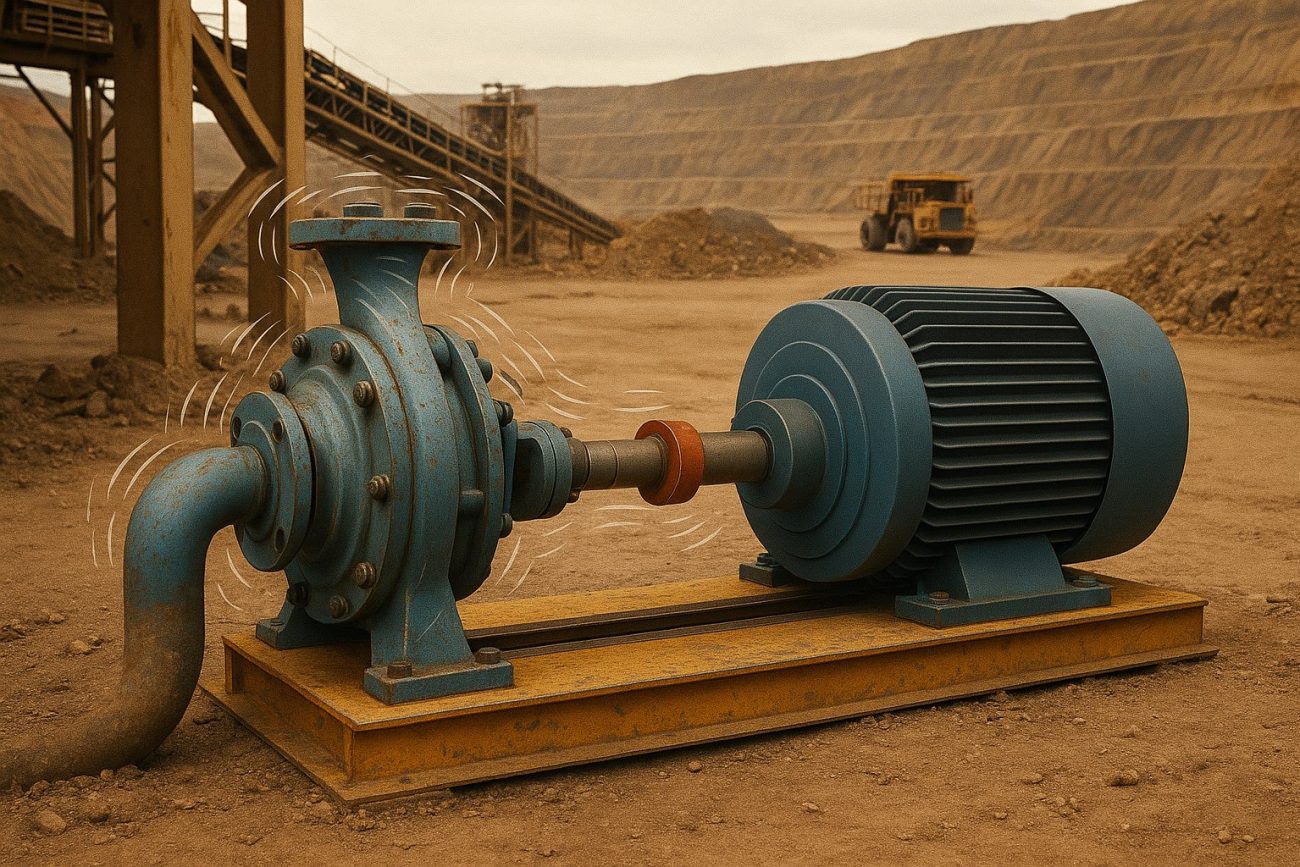
A centrifugal pump that starts vibrating more than usual is telling you something has changed. The cause could be mechanical, hydraulic, operational, or elsewhere in the pump system.
Vibration is usually a symptom of another problem. Replacing bearings, tightening hold-down bolts or realigning a pump may reduce it temporarily. If the actual cause is cavitation, operation away from the preferred operating region, pipe strain or another system condition, the vibration will return.
Good vibration troubleshooting starts by establishing what changed, where the vibration occurs and under what operating conditions it gets better or worse.
What causes vibration in a centrifugal pump?
Vibration is mechanical movement around an equilibrium position. Every operating centrifugal pump vibrates to some degree because rotating components, fluid forces and the driver generate dynamic loads.
Problems develop when vibration increases, changes character or reaches a level that threatens reliability.
Common causes fall into three broad groups:
- mechanical problems, such as imbalance, misalignment, looseness or bearing damage
- hydraulic problems, such as cavitation, recirculation or disturbed inlet flow
- system and operating problems, such as pipe strain, structural resonance or operation well away from the intended duty point
Several causes can exist at the same time. A hydraulic problem may eventually damage bearings or seals, adding new vibration frequencies to the original signature. An overall vibration reading therefore needs to be considered alongside frequency, operating conditions and the mechanical condition of the pump.
Mechanical causes of centrifugal pump vibration
Mechanical faults are a logical starting point when vibration occurs consistently across the operating range.
Impeller or rotor imbalance
A rotating assembly should distribute its mass evenly around its axis of rotation. If it does not, centrifugal force creates vibration as the assembly turns.
An impeller can become unbalanced through:
- uneven wear
- solids build-up
- corrosion
- erosion
- physical damage
- manufacturing or repair errors
The vibration associated with imbalance commonly has a strong component at running speed. Other faults can produce vibration at the same frequency, so running-speed vibration should be treated as diagnostic evidence rather than proof of imbalance.
Pump and driver misalignment
Misalignment occurs when the pump shaft and driver shaft do not operate on the intended common centreline.
Angular, offset or combined misalignment can increase loads on bearings and couplings. Depending on the installation and fault, vibration may appear at running speed and its harmonics.
Check alignment under conditions that represent normal operation as closely as practical. A pump aligned while cold can move as pipework, casing and baseplate temperatures change.
Measure alignment rather than judging it visually. A coupling that appears straight can still have enough angular or offset error to affect the machine.
Mechanical looseness
Loose hold-down bolts, bearing fits, baseplate connections or other structural components can allow movement that should otherwise be constrained.
Looseness can produce complicated vibration patterns because components may move, impact or change stiffness during operation.
Inspect the basic mechanical condition of the installation before moving to more involved diagnostics. Check mounting points, fasteners, supports and any visible movement.
Bearing problems
Rolling-element bearing defects can produce characteristic vibration frequencies associated with bearing geometry and shaft speed.
Bearing damage can also be secondary to another fault. Misalignment, excessive hydraulic loads, poor lubrication, contamination and structural movement can all shorten bearing life.
Repeatedly replacing the bearing without identifying the mechanism causing the damage may restore operation without improving reliability.
Hydraulic conditions can create significant vibration
A mechanically sound pump can vibrate excessively when its hydraulic operating conditions are poor. In these cases, work on the rotating assembly may have little effect because the excitation force originates in the fluid or pump system.
Cavitation
Cavitation occurs when local fluid pressure falls low enough for vapour bubbles to form and then collapse as they move into a higher-pressure region.
In a centrifugal pump, cavitation can produce noise, vibration, unstable performance and eventually material damage.
Possible contributors include:
- insufficient suction pressure
- excessive suction pipe losses
- restricted strainers or suction lines
- high fluid temperature
- unsuitable suction pipe geometry
- excessive pump speed or flow rate
A significant change in vibration as flow rate, suction conditions or liquid level changes points towards a hydraulic investigation.
Cavitation cannot be diagnosed reliably from noise alone. Check the operating conditions and the available Net Positive Suction Head (NPSH), which describes the suction pressure margin above the liquid’s vapour pressure.
Operation away from the preferred operating region
A centrifugal pump does not behave the same way at every point on its performance curve.
Operating too far from the pump’s preferred operating region can increase internal hydraulic forces, recirculation and pressure fluctuations. These forces act on the impeller and shaft and can increase vibration.
Compare vibration against flow rate when investigating this condition. If vibration rises or falls as the duty point changes, plot the actual operating point against the pump curve and check whether the pump is operating within an appropriate region.
Do not assume the pump is at its design flow because the motor is running and discharge pressure appears normal. Establish the actual flow and head before drawing conclusions about the pump’s operating condition.
Poor inlet flow conditions
A centrifugal pump requires suitable flow conditions at the suction nozzle. Disturbed inlet flow can create uneven hydraulic loading on the impeller before any mechanical fault develops.
Poor suction pipe geometry can introduce swirl, uneven velocity distribution or entrained gas before the fluid reaches the impeller.
Potential problems include poorly arranged bends, restrictions, inadequate straight pipe where required, unsuitable reducers, air pockets and other disturbances close to the suction nozzle.
When the inlet flow is poor, modifying or repairing the pump without correcting the upstream condition is unlikely to solve the vibration problem.
The pump may not be the source of the vibration
The location of a high vibration measurement does not necessarily identify its source. The pump, driver, baseplate, foundation, pipework and connected equipment form a mechanical system through which vibration can travel.
Structural resonance can amplify a relatively small excitation force when its frequency approaches a natural frequency of the installation.
Pipe strain can also affect vibration. Pipework should connect to the pump without forcing the casing into position. Excessive external loads can distort the casing, change shaft alignment and increase loads on bearings or mechanical seals.
Take measurements at several locations when tracing the source. Comparing vibration across the pump, driver, bearing housings, baseplate and nearby structure can show where vibration is highest and how it changes through the installation.
How to troubleshoot centrifugal pump vibration
Start with evidence rather than the component you suspect.
First, establish whether the vibration is abnormal. Compare current measurements with previous readings taken under similar operating conditions where records are available.
Document the operating condition at the same time. Useful parameters include:
- flow rate
- suction and discharge pressure
- pump speed
- fluid condition and temperature where relevant
- valve positions
- tank or sump level
- vibration measurement locations and directions
Inspect the installation for loose mounting points, damaged components, pipe movement, leaks, unusual noise and signs of overheating.
Next, compare vibration with operating conditions. A strong relationship between vibration and flow rate can indicate a hydraulic or system problem. Vibration strongly associated with rotational speed may direct the investigation towards rotating components or structural response.
Frequency analysis can provide more detail than an overall vibration value. A vibration spectrum separates the measured vibration into its frequency components, allowing the investigator to compare running speed, harmonics, vane-pass frequencies and bearing-related frequencies.
These frequencies are diagnostic clues rather than automatic fault codes. Interpret them alongside operating data, inspection findings and the history of the machine.
Why vibration trends matter
A single vibration measurement records the machine at one point in time. Trending repeated measurements shows whether its behaviour is stable or changing.
For condition monitoring, take readings from consistent locations and directions under comparable operating conditions. Otherwise, changes in the data may reflect the measurement method or operating duty rather than deterioration in the machine.
Baseline data from a pump in known good condition gives subsequent readings useful context. A gradual increase from a historically stable level may justify investigation even when the latest reading remains below a general alarm threshold.
The opposite can also occur. Some installations have higher stable vibration levels because of their construction, speed or supporting structure. A single generic limit cannot describe every machine condition.
Applicable vibration standards and equipment-specific limits provide useful acceptance or severity criteria. Combine them with trend data, operating conditions and knowledge of the installation.
Correct the condition causing the vibration
Reducing the vibration reading is not the same as removing its cause.
If the investigation identifies imbalance, determine what produced the imbalance. If alignment is outside tolerance, check for pipe strain, thermal movement or installation problems before treating alignment as an isolated fault. If vibration increases when the pump operates away from its intended duty, investigate why the system is forcing the pump into that operating region.
Apply the same approach to bearing failures. Replacing a damaged bearing restores the component, but reliability will not improve if misalignment, excessive hydraulic loading, contamination or another damaging condition remains.
Effective vibration troubleshooting combines machine condition, hydraulic performance and the behaviour of the wider pump system. The objective is to identify the force generating the abnormal vibration and remove its cause before secondary damage develops.
- Every centrifugal pump produces some vibration. A change in level, frequency or behaviour provides useful diagnostic information.
- Mechanical causes include imbalance, misalignment, looseness and bearing damage.
- Hydraulic causes include cavitation, disturbed inlet flow and operation away from the preferred operating region.
- Vibration measured at the pump can originate from the driver, pipework, baseplate, foundation or another connected component.
- Compare vibration with flow, pressure, speed and other operating conditions rather than relying on an overall vibration value alone.
- Trend measurements over time and investigate the condition causing the change before replacing components.
Last Updated on September 4, 2026 by TPE
