
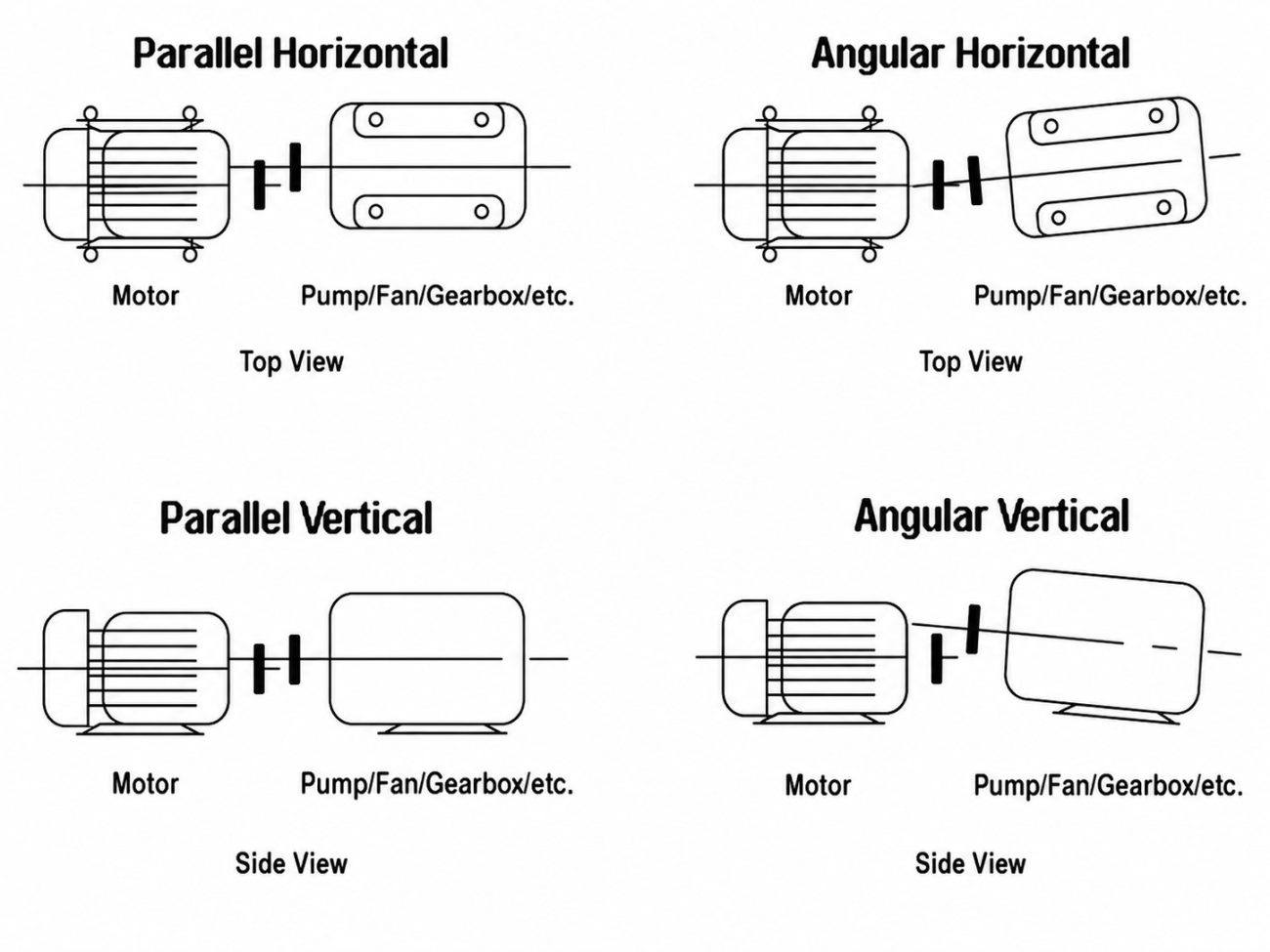
Pump and motor misalignment is a common cause of vibration, coupling wear, bearing damage, and mechanical seal leakage. The problem often starts with a small error at the shaft centreline. Once the pump is running, that small error can create repeated loads on the motor, coupling, pump shaft, bearings, and seal.
The diagram shows four basic misalignment patterns:
- parallel horizontal misalignment
- angular horizontal misalignment
- parallel vertical misalignment
- angular vertical misalignment
These categories are useful because they show where the alignment error is coming from. In real pump installations, the fault is often a combination of two or more types. A motor may be too high, slightly angled, and offset sideways at the same time.
This article explains what each misalignment type means, how it affects the pump set, and what maintenance teams should check before making corrections.
What pump and motor alignment means
Shaft alignment means positioning the motor shaft and pump shaft so they run on the same intended centreline.
The motor drives the pump through a coupling. A flexible coupling can tolerate a limited amount of movement, but it does not make poor alignment acceptable. If the shafts are offset or angled, the coupling has to flex during every revolution. That movement creates extra load on the connected equipment.
Good alignment helps reduce:
- vibration
- coupling temperature
- bearing load
- seal face movement
- shaft stress
- unplanned maintenance
Check alignment both horizontally and vertically, correct soft foot before making adjustments, and recheck the readings after tightening the hold-down bolts.
Parallel horizontal misalignment
Parallel horizontal misalignment occurs when the pump and motor shafts are parallel from the top view, but one shaft sits to the left or right of the other.
The shafts point in the same direction, but their centrelines do not meet. This is a sideways offset.
Common causes include poor initial positioning, movement during maintenance, loose hold-down bolts, baseplate distortion, or pipe strain pulling the pump out of position.
Pipe strain means external force from the pipework is being transferred into the pump casing. This can happen when pipe flanges do not line up naturally to the pump and are pulled into position with bolts or by another force. If pipe strain moves the pump sideways, aligning the motor to that position may not solve the real problem.
Correction usually involves moving the motor sideways until the shaft centrelines line up. Use controlled movement where possible. Small sideways adjustments can change the alignment reading significantly.
Angular horizontal misalignment
Angular horizontal misalignment occurs when the shafts are at an angle when viewed from above.
In this case, the motor shaft does not point along the same line as the pump shaft. If both shaft centrelines were extended, they would cross instead of staying parallel.
This type of misalignment can occur when one end of the motor is too far left or right compared with the other end. It may happen after motor replacement, coupling work, or baseplate movement.
Angular horizontal misalignment often causes uneven coupling loading. Depending on the coupling type and severity of the error, it can also contribute to vibration and bearing stress.
Correction usually involves rotating the motor slightly in the horizontal plane. Moving one motor foot or one end of the motor may reduce the angular error, but it can also introduce parallel offset. For that reason, the alignment should be measured again after each correction.
Parallel vertical misalignment
Parallel vertical misalignment occurs when one shaft is higher or lower than the other, while the shafts remain parallel when viewed from the side.
This is a height error. The motor shaft may sit above or below the pump shaft, even though both shafts point in the same direction.
Vertical correction is usually made with shims under the motor feet. Shims are thin metal plates used to raise the motor by a controlled amount. Adding shims raises the motor. Removing shims lowers it.
Before changing shims, check for soft foot. Soft foot occurs when one or more motor feet do not sit flat on the baseplate. When the hold-down bolts are tightened, the motor frame can twist. This changes the alignment reading and may add stress to the motor bearings.
Common causes of vertical parallel misalignment include:
- incorrect shim thickness
- damaged or dirty shims
- corrosion under the motor feet
- uneven baseplate pads
- motor replacement
- coupling replacement
Clean mounting surfaces matter. Dirt, paint flakes, burrs, or stacked damaged shims can all affect the final alignment.
Angular vertical misalignment
Angular vertical misalignment occurs when the shafts are at an angle when viewed from the side.
One end of the motor may be too high or too low relative to the other end. The shafts are not only different in height; they also point in different vertical directions.
This fault is corrected by changing shim thickness differently between the drive-end and non-drive-end motor feet. For example, adding shim under one pair of feet will tilt the motor. Removing shim from one pair of feet will tilt it in the opposite direction.
Angular vertical misalignment needs careful measurement because it can look similar to parallel vertical misalignment at the coupling. A single measurement at the coupling does not give enough information to calculate the correction. The distance between the coupling and the motor feet affects how many shims needs to be added or removed.
Dial indicator methods and laser alignment tools both help identify this difference. The method matters less than the discipline of measuring, correcting, tightening, and checking again.
Most pump sets have more than one alignment error
The four misalignment types are useful for diagnosis, but field conditions are rarely that neat.
A pump and motor set may have:
- vertical offset
- vertical angular error
- horizontal offset
- horizontal angular error
all at the same time.
Correcting one error can change another. For example, adding shims to correct vertical angular misalignment can also affect vertical offset. Moving the motor sideways to correct horizontal offset can change the horizontal angle.
This is why alignment is an iterative task. Measure the as-found condition, make controlled corrections, tighten the bolts, and then measure the final condition. The final reading after bolt tightening is the one that matters.
Why misalignment damages pump equipment
Misalignment creates repeated mechanical load. Every shaft revolution forces the coupling to accommodate an error between the motor and pump shaft positions.
That load can show up as:
| Symptom | Possible cause |
|---|---|
| Coupling runs hot | Excessive flexing due to offset or angular error |
| Coupling element wears quickly | Misalignment, overload, or wrong coupling installation |
| Bearing temperature increases | Extra radial or axial load |
| Mechanical seal leaks | Shaft movement, vibration, or seal face disturbance |
| Vibration increases after maintenance | Motor moved, soft foot introduced, or pipe strain changed |
| Alignment changes after bolts are tightened | Soft foot, base distortion, or poor shim condition |
These symptoms do not prove misalignment by themselves. They tell the maintenance team where to start checking.
Mechanical seals are especially sensitive to alignment problems. A seal depends on stable shaft rotation and controlled face contact. If misalignment increases shaft movement or vibration, the seal faces may open, wear unevenly, or overheat.
What to check before correcting alignment
Do not start by moving the motor. First, check whether the pump set is in a suitable condition for alignment.
A practical sequence is:
- Isolate and lock out the equipment.
- Inspect the coupling, guard, and visible shaft condition.
- Check that the pump is not being pulled by the pipework.
- Confirm the baseplate and hold-down bolts are secure.
- Check and correct soft foot on the motor.
- Measure vertical and horizontal alignment.
- Correct vertical alignment with shims.
- Correct horizontal alignment by moving the motor.
- Tighten the hold-down bolts in a controlled sequence.
- Recheck and record the final readings.
Thermal growth may also need to be considered. Thermal growth is the movement of equipment caused by temperature change during operation. Some pump sets are intentionally aligned slightly out of position when cold so the shafts line up correctly at operating temperature.
Use the site alignment procedure or engineering specification where thermal growth targets are required.
Common alignment mistakes
One common mistake is relying on the coupling to compensate for poor installation. A flexible coupling has limits. It reduces the effect of small movement, but it does not remove the forces caused by misalignment.
Another mistake is ignoring soft foot. If the motor frame twists when the bolts are tightened, the alignment can change even after good readings are achieved.
A third mistake is aligning the motor while the pump is under pipe strain. The pump should sit naturally on its base. Pipework should meet the pump flanges without forcing the casing into position.
The final mistake is stopping before the final check. Alignment should be verified after all corrections are complete and after the hold-down bolts are tightened.
Ready to align? First check: Site Preparation & Baseplate Leveling covers the foundation work and The Pump Start-Up & Shut-Down Checklist (alignment is part of start-up).
Key takeaways
- Pump and motor misalignment can be parallel, angular, horizontal, vertical, or a combination of these.
- Parallel misalignment means the shafts are offset but pointing in the same direction.
- Angular misalignment means the shafts point in different directions.
- Vertical alignment is usually corrected with shims under the motor feet.
- Horizontal alignment is usually corrected by controlled sideways movement of the motor.
- Check soft foot, pipe strain, and final bolt-tightened readings before accepting the alignment.
Last Updated on August 18, 2026 by TPE
