
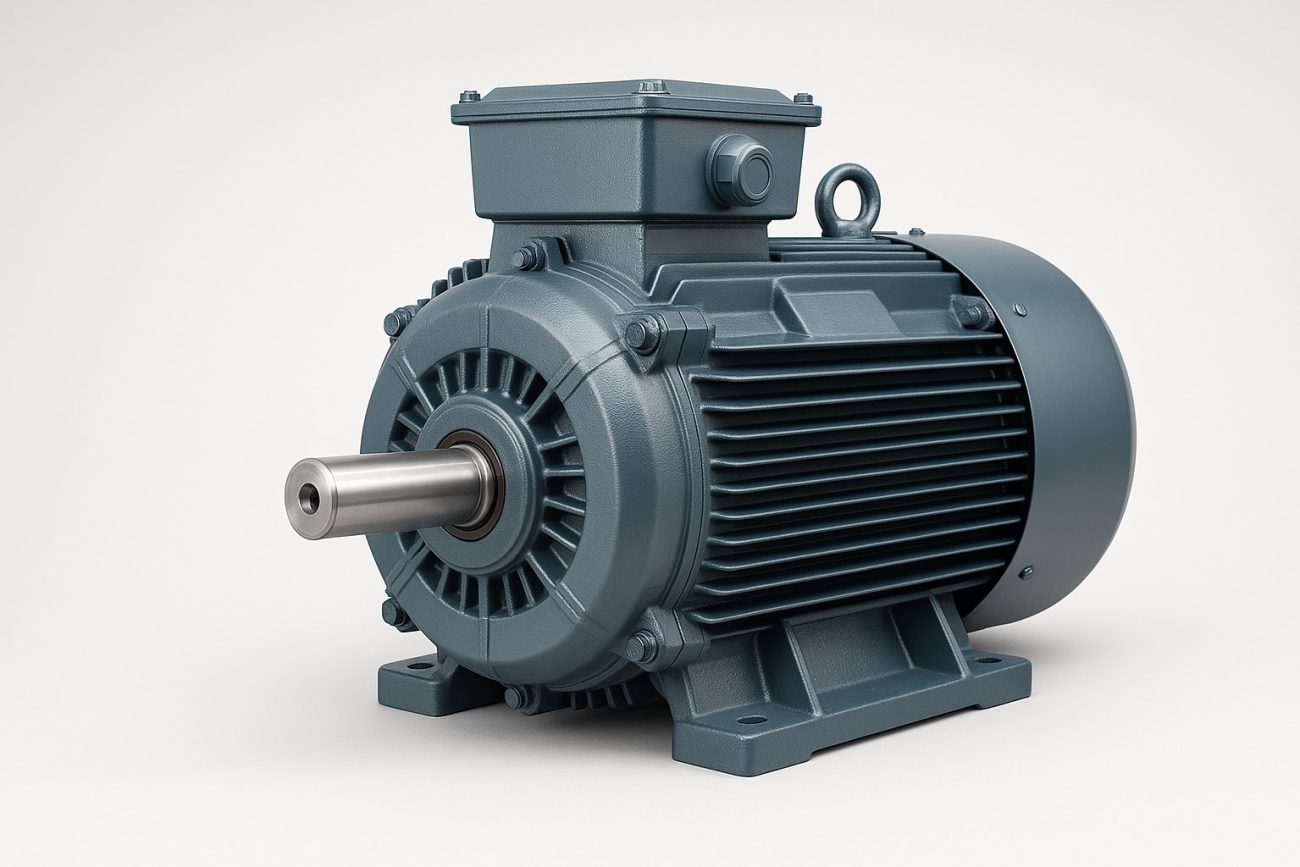
Electric motors are at the core of almost every industrial and mining operation. Whether driving conveyors, pumps, crushers, or ventilation fans, motor speed has a direct impact on performance, efficiency, and long-term reliability.
Yet it’s a specification that’s often taken for granted. Selecting the wrong speed can lead to mismatched equipment, unnecessary wear, and costly inefficiencies.
This guide explains standard motor speeds, additional speed options, and practical considerations for heavy-duty environments.
1. The Basics: Synchronous Speed
In AC motors, speed is determined by the power supply frequency and the number of poles in the stator winding.
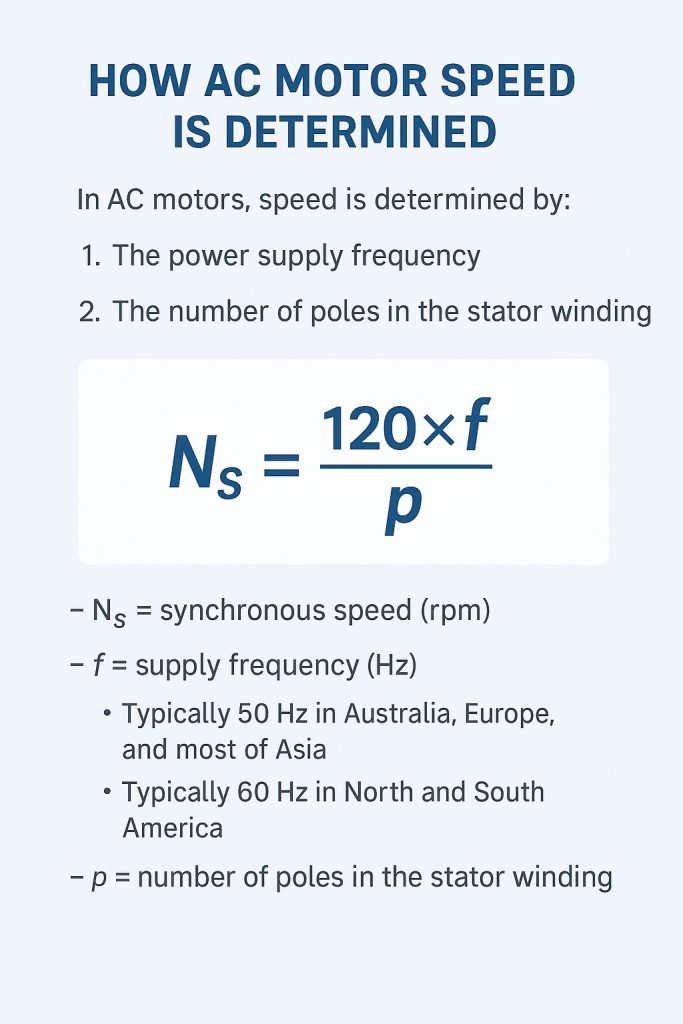
Where:
- NsN_sNs = synchronous speed (rpm)
- fff = frequency (Hz) — typically 50 Hz in Australia, Europe, and much of Asia; 60 Hz in North and South America
- ppp = number of poles
Synchronous Speed Table
| Poles | 50 Hz | 60 Hz |
|---|---|---|
| 2 | 3000 | 3600 |
| 4 | 1500 | 1800 |
| 6 | 1000 | 1200 |
| 8 | 750 | 900 |
| 10 | 600 | 720 |
| 12 | 500 | 600 |
| 16 | 375 | 450 |
| 20 | 300 | 360 |
| 24 | 250 | 300 |
2. Why Real Motors Don’t Quite Reach Those Numbers
Most industrial motors are induction types, which run slightly below synchronous speed. This difference, called slip, is typically 1–4% at full load.
Example full-load speeds at 50 Hz:
- 2-pole: ~2850–2970 rpm
- 4-pole: ~1420–1485 rpm
- 6-pole: ~930–990 rpm
- 8-pole: ~700–745 rpm
Slip increases slightly with load and is necessary for torque production.
3. What’s Standard and What’s Available
In most heavy-duty applications:
- Standard speeds: 2-pole, 4-pole, 6-pole, and 8-pole designs (≈ 3000, 1500, 1000, 750 rpm at 50 Hz).
- Extended low-speed options: 10, 12, 16, 20, and 24 poles for direct-drive high-torque applications such as large conveyors, mills, and crushers.
- Synchronous motors: Operate exactly at synchronous speed for applications needing high torque, efficiency, or precise speed control.
- Two-speed motors: Pole-changing designs (often 2:1 speed ratio) for simple fixed-speed changes without variable-frequency drives.
4. The Role of Variable-Frequency Drives (VFDs)
VFDs allow wide-range speed control:
- Below base speed: Speeds can be reduced significantly while maintaining torque, but cooling can become an issue. TEFC (totally enclosed fan-cooled) motors may require separate blowers at low speeds.
- Above base speed: Overspeeding is possible within mechanical and thermal limits, but torque decreases in the constant power range. Always confirm maximum safe operating speed.
For variable-torque loads like pumps and fans, reducing speed can greatly reduce energy use (power ∝ speed³). For constant-torque loads such as conveyors and positive-displacement pumps, torque demand stays the same, so thermal limits are critical.
5. Choosing the Right Speed for the Job
- Centrifugal pumps & fans: Commonly use 2- or 4-pole motors. VFDs can fine-tune output and improve efficiency.
- Positive-displacement pumps, crushers, conveyors: Often benefit from higher pole counts (slower speeds) or direct-drive low-speed designs to eliminate gearboxes.
- Two-speed applications: Pole-changing motors work where only two fixed speeds are required.
6. Practical Tips for Specifying Motors
- Confirm nameplate speed and slip at full load, not just catalogue values.
- For continuous low-speed operation, specify forced cooling or motors designed for inverter duty.
- Check mechanical overspeed limits before exceeding base frequency.
- Match motor speed to the load to avoid unnecessary gearboxes and inefficiencies.
- In high-torque applications, consider high-pole direct-drive designs to reduce gearbox maintenance and improve reliability.
Key Takeaway
Motor speed is more than just a number on a datasheet. The right choice improves efficiency, extends equipment life, and reduces maintenance costs. By understanding standard and alternative speeds — and the role of modern control methods — you can ensure the motor is perfectly matched to the demands of your industrial or mining application.
