
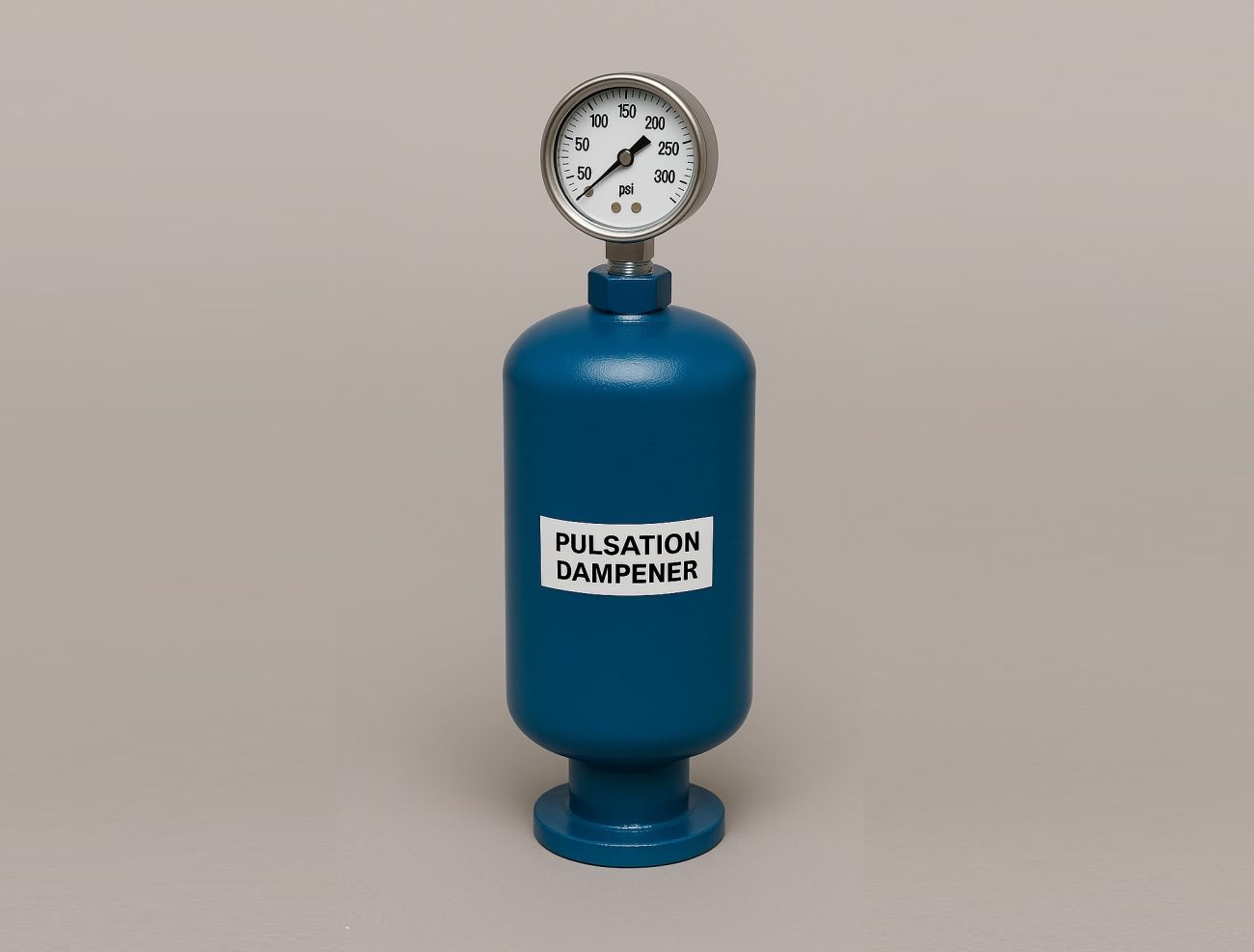
Positive displacement pumps are reliable workhorses, but they don’t deliver perfectly smooth flow. Each stroke or diaphragm movement sends a pulse of liquid into the line. Left unchecked, these pressure fluctuations can create vibration, noise, and premature wear throughout a system.
This is where pulsation dampeners come in.
What Is a Pulsation Dampener?
A pulsation dampener is a device fitted to the suction or discharge side of a pump to reduce flow and pressure fluctuations. It acts like a shock absorber:
- During a pressure spike, the dampener absorbs excess energy.
- When the pressure dips, it releases fluid back into the line.

The result is a smoother, more consistent flow and lower stress on the piping and components.
Why Pulsations Happen
- Reciprocating pumps (piston, plunger, diaphragm) deliver fluid in strokes, not continuously.
- AODD pumps push fluid with each diaphragm movement, creating distinct pulses.
- Peristaltic hose pumps displace a slug of fluid as each roller or shoe passes the hose.
All of these create a characteristic “sawtooth” flow profile that can be hard on downstream equipment.
Types of Pulsation Dampeners
- Bladder-Type
- Uses a pre-charged bladder filled with gas (often nitrogen).
- Absorbs pressure spikes and releases energy between pulses.
- Widely used on AODD and diaphragm pumps.
- Diaphragm-Type
- A flexible diaphragm separates the process fluid from the gas charge.
- Suitable for corrosive or sanitary duties, where product must not contact the gas.
- Hydraulic Accumulator Type
- Common on high-pressure piston and plunger pumps.
- Designed for very demanding, high-energy systems such as water jetting or oilfield injection.
Benefits of Using a Pulsation Dampener
- Reduces vibration and noise in piping systems.
- Protects instruments such as pressure gauges and flow meters from damage.
- Extends pump life by reducing diaphragm, valve, and seal stress.
- Improves process control where steady flow is critical, such as in dosing or spraying applications.
- Prevents water hammer and helps maintain pipeline integrity.
Where You’ll See Them
- On the discharge side of AODD pumps, to smooth out the characteristic pulsing flow.
- In peristaltic pump systems, when accurate dosing or sensitive downstream equipment is involved.
- On plunger and piston pumps used in high-pressure industrial and mining services.
- In food, beverage, and pharmaceutical processing lines, where smooth, laminar flow protects product quality.
Good Practice for Installation
- Place the dampener as close to the pump discharge as possible.
- Charge the gas to the correct pressure (typically 60–80% of operating line pressure, depending on design).
- Use dampeners sized to the pump’s flow rate and discharge pressure.
- Inspect and maintain the gas charge periodically — a dampener that loses charge will not perform.
Final Thoughts
Pulsation dampeners may look like simple vessels, but their role in a pumping system is critical. By absorbing pressure spikes and releasing energy between pulses, they protect pumps, piping, and instrumentation from the damaging effects of cyclic flow.
If your system suffers from vibration, noisy discharge lines, instrument failures, or uneven product delivery, adding a pulsation dampener may be the simplest and most effective fix.
Last Updated on August 25, 2025 by TPE
