
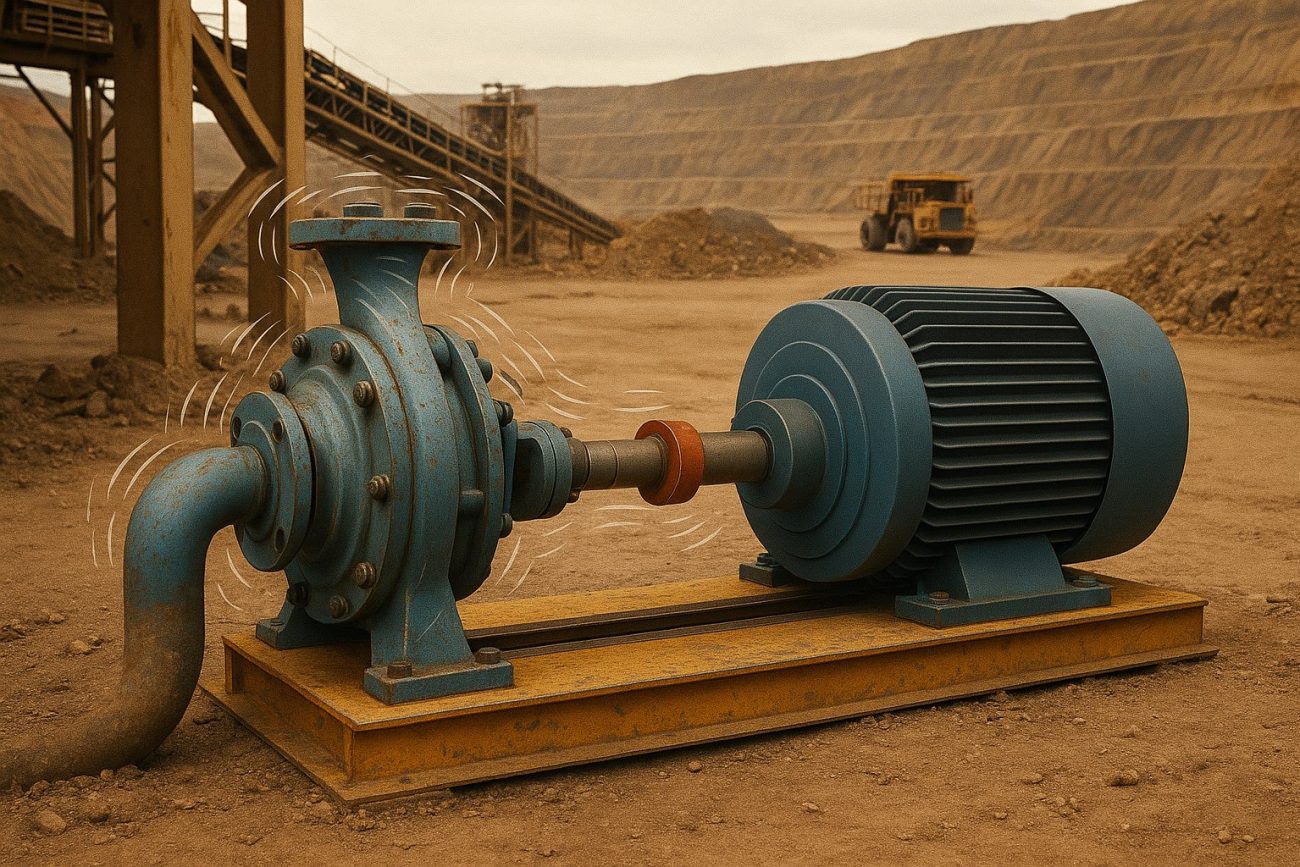
Ask anyone who’s worked around pumps long enough, and they’ll tell you: nothing chews through bearings, seals, and couplings faster than poor alignment. You can buy the best pump on the market, install it on a solid foundation, and still end up with vibration, noise, and constant breakdowns — all because the pump and driver aren’t sitting square with each other.
I’ve seen plants spend thousands replacing seals every couple of months, only to discover that the root cause wasn’t the seal design at all. It was misalignment.
What Exactly Is Pump Alignment?
Pump alignment is simply the process of making sure the pump shaft and driver shaft share the same centreline. Think of two drill bits joined together. If they’re even a fraction out, the whole setup wobbles. In pumps, that “wobble” turns into vibration, heat, and premature wear.
There are two main errors:
- Angular misalignment – the shafts meet at an angle.
- Offset (parallel) misalignment – the shafts are parallel but shifted sideways.
In the real world, you usually end up with a bit of both.
Why It Matters
- Shorter seal and bearing life – misalignment puts uneven stress on rotating parts.
- Energy waste – it takes more power to drive a pump that’s fighting against itself.
- Downtime – seals fail, couplings crack, foundations loosen. Once that cycle starts, you’re stuck in a loop of repairs.
Alignment isn’t a “nice to have.” It’s the difference between a pump that runs reliably for years and one that fails before its first scheduled service.
Common Causes of Misalignment
Misalignment doesn’t always start with the fitter. It creeps in over time:
- Thermal growth – as pumps and motors heat up, they expand. A motor perfectly aligned cold may drift out once it’s running at temperature.
- Foundation settling – concrete bases and grout shift with vibration and age.
- Pipe strain – tightening up heavy pipework can pull the pump off centre.
- Wear and tear – coupling inserts compress, bolts loosen, soft foot develops.
Tools You’ll Need
There are three main approaches:
- Straightedge and feeler gauges – the old-school method. Good for rough alignment but not precise enough for critical service.
- Dial indicators – more accurate, but fiddly and time-consuming.
- Laser alignment tools – fast, accurate, and the standard in most plants today. They don’t just give numbers — they show you exactly how much to move and in which direction.
The Alignment Process (Step by Step)
- Shut down and lock out the pump. Safety comes first.
- Remove the coupling or guard. You need clear access to measure properly.
- Check for soft foot. Loosen each motor foot one at a time. If one lifts off, shim it before proceeding.
- Rough alignment. Use a straightedge or feeler gauge to get close.
- Precision alignment. Switch to dial indicators or laser tools. Measure at multiple positions (90° intervals) around the coupling to confirm.
- Account for thermal growth. For example, a hot-running motor may need to start slightly low to end up correct at operating temperature.
- Tighten, recheck, repeat. Small adjustments can throw things off, so always verify after tightening bolts.
- Reinstall the coupling and guard. Don’t leave it open — safety must never be an afterthought.
Read full start up and shut down procedure here.
For most industrial applications, alignment should be within 0.5–1.0 mils (0.025–0.050 mm). It doesn’t sound like much, but at 1,500 rpm, that tolerance makes the difference between smooth running and vibration that tears the machine apart.
Signs of Misalignment in the Field
You don’t always need instruments to suspect trouble. Look out for:
- Coupling inserts wearing unevenly
- Excessive vibration or noise
- Hot bearings
- Frequent seal leaks
- Pipework that looks under strain after tightening bolts
These are the everyday warning signs maintenance crews often spot long before a catastrophic failure.
Final Thoughts
Pump alignment isn’t glamorous, but it’s one of the highest ROI tasks in maintenance. A laser alignment kit might feel like an expense, but when you compare it to the cost of replacing bearings, seals, or even a pump every year, it’s a bargain.
I’ve seen plants cut their seal failures in half simply by tightening up their alignment practices. That’s not theory — that’s real-world experience.
So next time you’re commissioning a pump, don’t rush it. Take the extra hour to get the shafts lined up properly. It’ll save you days of downtime later.
As I like to say on site: “Ignore alignment, and you’ll be back with a spanner sooner than you think.”
Last Updated on April 2, 2026 by TPE
