
When selecting a chemical pump, gasket, seal, or pipe material, it’s common to ask:
“Is this compatible with sulfuric acid?”
But that question alone isn’t enough.
The real question is:
“Is this material compatible with sulfuric acid at X% concentration and Y°C temperature?”
Because here’s the truth:
Chemical compatibility changes drastically with concentration.
Let’s Take Sulfuric Acid as an Example
Sulfuric acid (H₂SO₄) is one of the most widely used industrial chemicals — found in mining, fertiliser production, water treatment, and more. But it behaves very differently at different concentrations:
- 10–30% Sulfuric Acid
Highly corrosive and oxidising.
Materials like stainless steel (316) can suffer severe corrosion.
PVC, PTFE, and PVDF often perform better here. - 50–70% Sulfuric Acid
Still corrosive, but with reduced oxidising power.
316 stainless might survive, but still not ideal long-term.
Plastics like polypropylene or PVDF are preferred. - 98% Sulfuric Acid (Concentrated)
Surprisingly less aggressive to some metals — including carbon steel — but only when dry and at room temp.
The moment moisture is introduced, it becomes highly corrosive.
PTFE-lined components are commonly used here.
Why It Matters in Pump Selection
Choosing the wrong material — even if it’s “rated for sulfuric acid” — can lead to:
- Swelling or cracking of hoses or seals
- Pitting and corrosion of pump casings or impellers
- Unexpected leaks or catastrophic failures
- Voiding of warranties or safety compliance
Compatibility data without concentration context is incomplete and misleading.
It’s Not Just Sulfuric Acid
The same rule applies to other chemicals:
- Hydrochloric acid is more aggressive at lower concentrations.
- Sodium hypochlorite (bleach) degrades some rubbers even at trace levels.
- Sodium hydroxide (caustic soda) may attack aluminium but not stainless steel.
- Nitric acid becomes extremely aggressive above 20%.
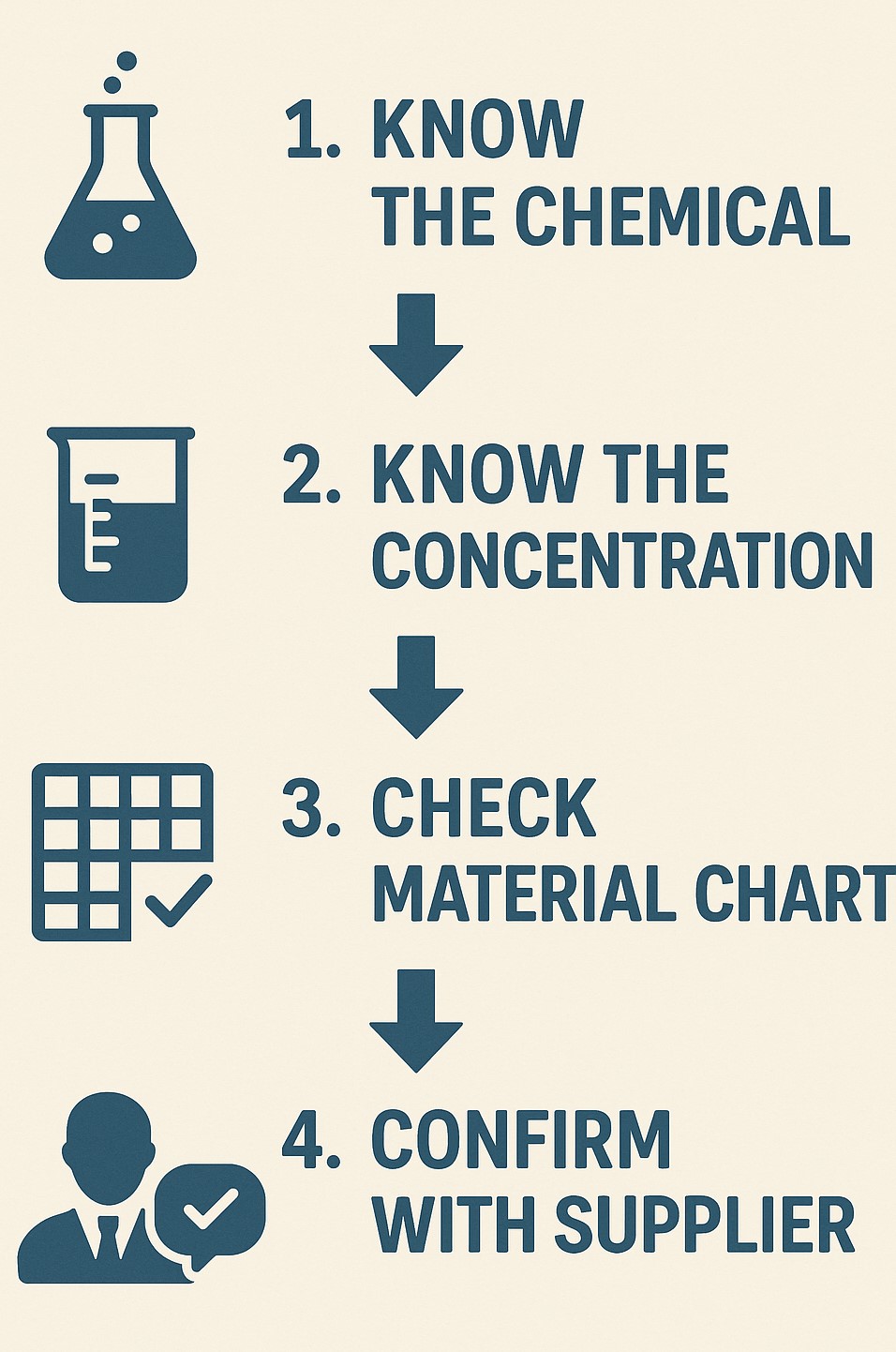
So when you’re reviewing chemical compatibility charts or asking your pump supplier for advice, always provide:
- Chemical name
- Exact concentration (%)
- Operating temperature (°C or °F)
- Flow rate or pressure (if relevant)
Need Help Choosing the Right Materials?
The Pump Expert team work with hundreds of chemical applications every year. Whether you’re dosing a weak acid, transferring high-strength solvents, or dealing with variable conditions — we’ll help you find a solution that lasts.
Stop guessing. Start specifying.
Let’s make sure your system is built for the chemical and the concentration you’re actually handling.
