
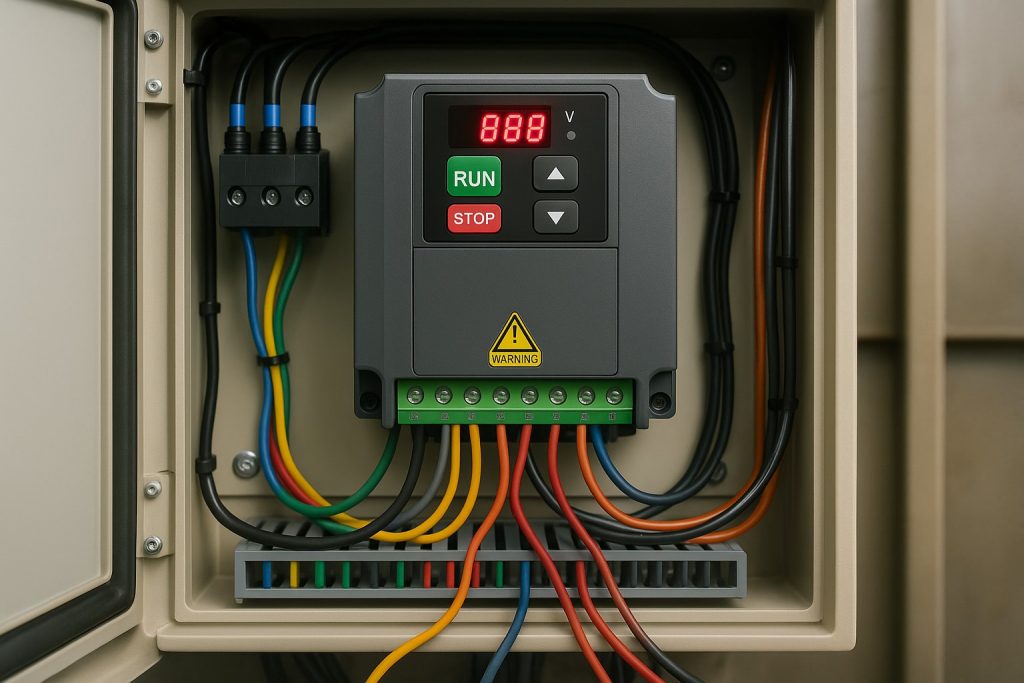
There is no single best way to control pump flow. A variable speed drive (VSD) is usually the most efficient option for continuously variable demand, but it is not free of trade-offs, and running a motor at low speed for long periods can shorten motor life if the motor and cooling arrangement are not suited to it. Throttling and bypass are cheaper to install but waste energy as heat and pressure drop. Multiple or staged pumps suit step changes in demand rather than fine, continuous control. The right method depends on how often demand changes, how far it changes, and what the system can tolerate.
Quick comparison
| Method | How it changes flow | Energy efficiency | Capital cost | Best suited to |
|---|---|---|---|---|
| Throttling (discharge valve) | Adds resistance to the system curve, shifting the operating point left | Low — wasted energy is dissipated as heat and pressure drop across the valve | Low | Infrequent adjustment, small systems, retrofit situations |
| Bypass / recirculation | Diverts part of the flow back to source or tank, keeping the pump on its curve | Very low — the pump does full work on flow that is never delivered | Low to moderate | Protecting against low-flow or deadhead conditions, not primary flow control |
| Variable speed drive (VSD) | Changes pump speed, shifting the whole pump curve per the affinity laws | High across a wide operating range | Moderate to high | Continuous or frequent variable demand, especially where the system has significant friction losses |
| Multiple pumps (staged / parallel) | Brings pumps on or off line to match demand in steps | High at each step, but flow changes in increments rather than continuously | High | Step changes in demand, standby/redundancy requirements, large flow ranges |
Throttling a discharge valve

Throttling adds artificial resistance downstream of the pump. This steepens the system curve and shifts the pump’s operating point to a lower flow, higher head position on its curve.
The pump still does the same work as if it were producing full flow. The energy difference between what the pump produces and what the system actually needs is destroyed as heat and turbulence across the valve. This is why throttling has a low efficiency ranking in the table above — the wasted energy still has to be paid for at the motor.
Throttling suits situations where flow adjustment is occasional, the pressure drop across the valve is small relative to total system head, or where a VSD or additional pump cannot be justified for a minor and infrequent adjustment. It is a poor choice as the primary control method on a system where flow varies significantly and continuously, because the energy penalty compounds every hour the pump runs.
Throttling too far back can also push the pump towards its minimum continuous flow, increasing the risk of overheating, radial thrust, and cavitation. Check the pump curve for the minimum recommended flow and how far the pump is operating away from the best efficiency point before relying on heavy throttling.
Bypass and recirculation
A bypass line returns part of the pump’s discharge back to the suction source or a holding tank. The pump keeps running near its design point on the curve, while the bypass line absorbs the flow that is not needed downstream.
Bypass is generally less efficient than throttling, because the pump does full hydraulic work on the recirculated flow with no useful output at all. It is more commonly used as a protection method than a primary control method — for example, keeping flow through a positive displacement pump above a safe minimum, or preventing a centrifugal pump from operating too far left on its curve where it can overheat or cavitate. See minimum flow and cavitation risk for more on this protection role.
Where a bypass is fitted for protection, it should be sized to pass only the minimum flow required to protect the pump, not to act as the main way of adjusting delivered flow.
Variable speed drives (VSDs)
A VSD changes the pump’s rotational speed by varying the frequency of the electrical supply to the motor. The affinity laws describe how pump speed affects flow, head and power:
- Flow is proportional to speed
- Head is proportional to speed squared
- Power is proportional to speed cubed
Because power drops with the cube of speed, a modest speed reduction can produce a meaningful drop in power draw, provided the system curve is dominated by friction losses rather than static head. On systems with a large static head component (lifting fluid a fixed height, for example), the flow and energy benefit of slowing the pump is smaller, because static head does not reduce with speed.
The motor life trade-off at low speed
Running a VSD-controlled pump at reduced speed for extended periods is not free of risk to the motor. Standard totally enclosed fan-cooled (TEFC) induction motors rely on a shaft-mounted fan to move cooling air across the motor frame. That fan is also driven by the motor shaft, so its cooling airflow drops with speed. At low speed, the motor can generate less heat than at full load, but the reduced airflow can still leave the motor running hotter than its rating assumes for continuous duty, particularly if it is also carrying significant torque at low speed.
This is a genuine limitation, not a reason to avoid VSDs. IEC TS 60034-25, the application guide covering AC motors used with power drive systems, addresses this directly and includes derating requirements for converter-supplied motors. It means:
- Confirm with the motor manufacturer whether the motor is rated for continuous operation across the full speed range the application needs, or only down to a defined minimum speed
- Consider a motor with an independently powered (force-ventilated) cooling fan, or an inverter-duty motor rated for the intended speed range, where the application runs at low speed for extended periods
- Check the VSD manufacturer’s minimum speed guidance for the specific motor and load combination before specifying continuous low-speed operation
A VSD can also introduce electrical considerations such as harmonics and bearing currents on some motor and drive combinations. These are manufacturer- and installation-specific and should be confirmed with the drive and motor supplier rather than assumed.
VSDs generally suit systems with continuously or frequently variable demand, particularly where the system curve has a significant friction component, and where the capital cost of the drive is justified by ongoing energy savings.
Multiple pumps (staged or parallel operation)
Running two or more pumps in parallel, and bringing them on or off line as demand changes, gives step control rather than continuous control. Each pump runs near its own best efficiency point when it is running, rather than being throttled or slowed away from it.
This suits applications where demand moves in discrete steps — for example, a pump station where inflow varies with intermittent tanker deliveries or batch discharges — or where standby capacity and redundancy are already required for reliability reasons. The combined performance curve of pumps running in parallel is not a simple multiple of a single pump’s curve; the system curve and the number of pumps running both affect the actual operating point, so combined-curve behaviour should be checked against manufacturer curve data rather than assumed.
Staged pumps do not give the fine, continuous adjustment that a VSD provides. Some systems combine both: a VSD-controlled lead pump for fine control within a step, and fixed-speed pumps that stage on for larger demand increases.
Choosing between methods
The choice generally comes down to how demand behaves and what the system can tolerate:
- If demand is broadly constant with occasional small adjustments, throttling may be acceptable
- If a pump needs protection from running below its minimum flow, a bypass may be needed regardless of what else is used for primary control
- If demand varies continuously across a wide range, a VSD is usually the most efficient primary method, provided the motor and drive are correctly specified for the speed range required
- If demand changes in steps, or standby capacity is already required, staged or parallel pumps may suit better than trying to force continuous control onto a step-change duty
More than one method is often used together — for example, a VSD for fine control with a bypass retained as a low-flow protection measure, or staged pumps with a VSD on the lead unit.
What this comparison does not replace
This guide describes the general trade-offs between flow control methods. It does not replace a proper system curve analysis, a motor and drive compatibility check with the manufacturer, or an assessment of your specific duty cycle. Confirm VSD speed range, motor cooling arrangement, and minimum flow requirements with the pump and motor manufacturer before finalising a design.
FAQs
Does a VSD always save energy compared to throttling?
Usually, but not always. The saving depends on how much of the system’s head is friction loss (which drops with speed) versus static head (which does not). On systems with high static head and low friction loss, the energy benefit of slowing the pump is smaller, and the case for a VSD depends more on process control needs than energy savings alone.
Can I run a standard motor at low speed indefinitely on a VSD?
Not necessarily. A standard fan-cooled motor’s cooling airflow drops with shaft speed. Continuous low-speed running can leave the motor running hotter than intended unless it is rated for the full speed range or fitted with independent cooling. Confirm this with the motor manufacturer for your specific duty.
Is bypass ever a good primary flow control method?
It can work for simple, low-cost systems, but it is one of the least efficient options because the pump does full work on flow that delivers nothing. It is more commonly justified as a protection measure alongside another control method.
When do multiple pumps make more sense than a VSD?
When demand changes in steps rather than continuously, or when standby capacity is already required for reliability. Staging pumps on and off keeps each pump near its best efficiency point, but does not give the fine control a VSD provides within a step.
Read the pump affinity laws guide for more on how the affinity laws govern VSD performance. Always confirm VSD and motor sizing with the pump and motor manufacturer before specifying.
Last Updated on September 10, 2026 by TPE